ICML 2026


A human-centric audio-visual instance segmentation dataset for dynamic real-world scenes.
- 2026-05 AVTrack code, dataset, and project page released.
- 2026-05 AVTrack is accepted to ICML 2026 🎉
Yaoting Wang, Yun Zhou, Zipei Zhang, Henghui Ding
Institute of Big Data, College of Computer Science and Artificial Intelligence, Fudan University, Shanghai, China
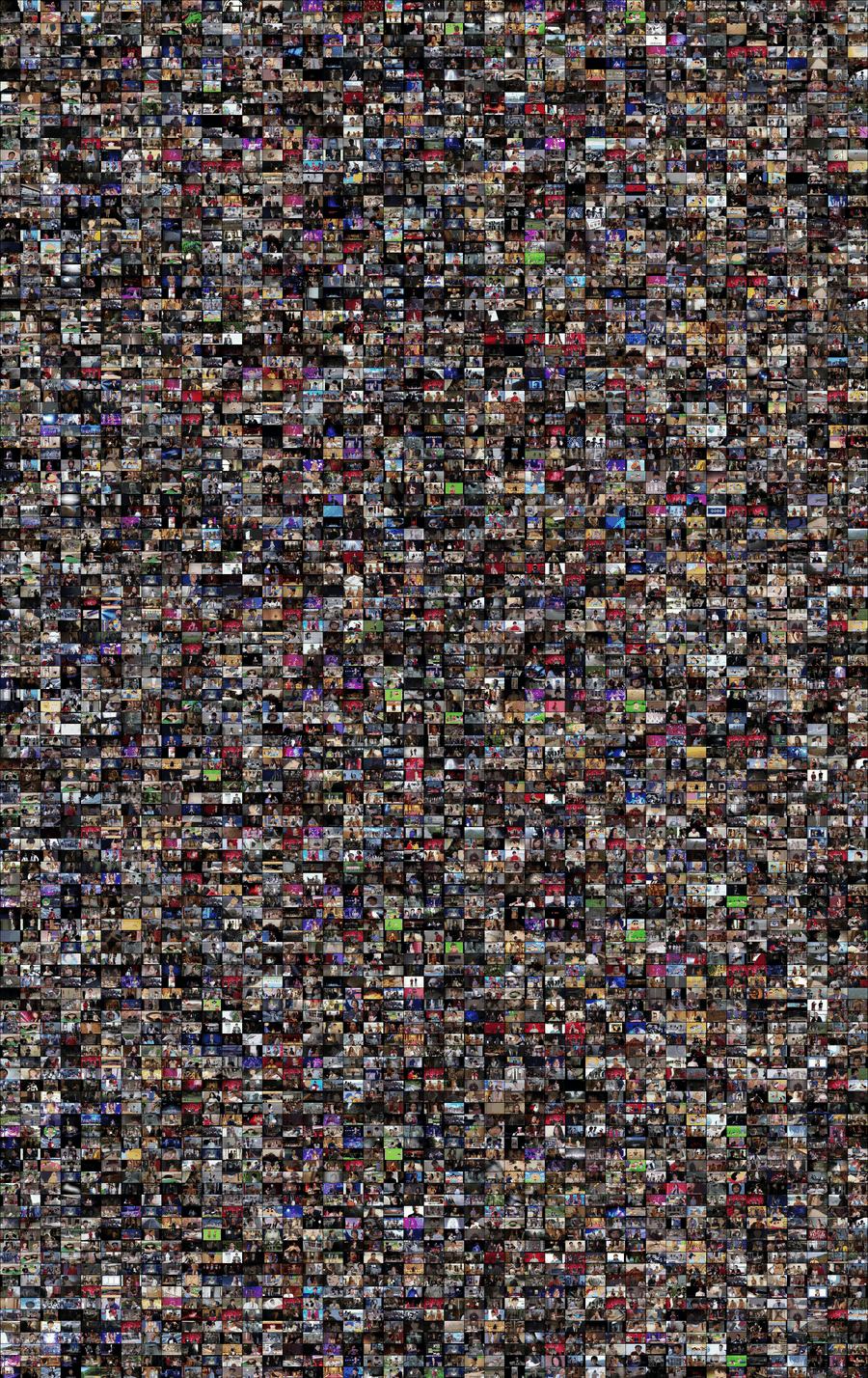
AVTrack is a human-centric audio-visual instance segmentation (AVIS) dataset built specifically for evaluation in dynamic, real-world scenes. It complements existing AVIS benchmarks — which often rely on static, single-speaker, or laboratory-style footage — with the kind of messy conditions that real applications actually see.
- 871 videos, 100% test split, averaging 54 s per clip.
- Pixel-level instance masks with cross-frame identity (tracking), plus aligned audio.
- Spans interviews, films, anime, operas, narrations, and stage performances — broad coverage of speakers, languages, and acoustic conditions.
- Per-video challenge attributes: camera motion, occlusion, position changes, overlapping speech, and more.
- Released with a training-free baseline (AVTracker) to bootstrap future research.
See the project page for figures and a dataset comparison table.
Input: Video Frames + Audio
         │
    ┌────┴────┐
    ▼         ▼
 SAM3      Whisper
 (Track)   (ASR)
    │         │
    │    [Optional: Mossformer2 speech separation]
    │         │
    │    Speech Chunks (with timestamps)
    │         │
    │    [Optional: Speaker similarity compression]
    │         │
    └────┬────┘
         ▼
   Local Window Analysis
   (VLM per-chunk: who is speaking?)
         │
         ▼ IoU matching (VLM bbox ↔ SAM3 mask)
         │
         ▼
   Global Window Analysis
   (VLM cross-frame: which frames = same person?)
   [or DeepFace in face variant]
         │
         ▼
   Output: Per-person tracklets (mask sequences)
AVTrack/
├── configs/                            # Hydra configuration (all hyperparams here)
│   ├── config.yaml                     #   Main config with defaults composition
│   ├── agent/                          #   Variant configs
│   │   ├── base.yaml                   #     Full method (default)
│   │   ├── no_separation.yaml          #     Ablation: disable Mossformer2 separation
│   │   ├── no_compression.yaml         #     Ablation: disable speech-chunk compression
│   │   ├── fix_window.yaml             #     Ablation: fixed 8 s window
│   │   └── face.yaml                   #     Global stage uses DeepFace instead of VLM
│   ├── model/                          #   Model selection configs (asr, vlm, tracker, speaker, separator)
│   ├── data/avtrack.yaml               #   Dataset paths (env-var driven)
│   └── eval/default.yaml               #   Evaluation metrics config
│
├── src/                                # Core source code
│   ├── agent/                          #   BaseAgent / SepAgent / FaceAgent + factory
│   ├── skills/                         #   ASR · SAM3 tracker · Qwen3-VL · ECAPA speaker · Mossformer2 · DeepFace
│   ├── data/                           #   AVTrackDataset loader
│   ├── evaluation/                     #   HOTA / DetA / AssA / IDF1 / MOTA via trackeval
│   ├── prompts/                        #   VLM prompt templates
│   └── utils/                          #   I/O, seeding, matching, text, visualization
│
├── scripts/
│   ├── run_inference.py                #   Hydra app: single-GPU & multi-GPU inference
│   ├── run_inference_one_video_example.py  # Single-video demo entry
│   └── run_eval.py                     #   Hydra app: evaluation
│
├── docs/                               # Algorithm/method notes
├── pyproject.toml                      # uv-managed project metadata
├── uv.lock                             # Pinned dependency lockfile
├── LICENSE                             # MIT
├── .env.example                        # Environment variable template
└── .gitignore
The project uses uv for dependency management. A pinned uv.lock is committed for reproducibility.
curl -LsSf https://astral.sh/uv/install.sh | shgit clone https://github.com/FudanCVL/AVTrack.git
cd AVTrack
# Core dependencies (Python 3.12 + PyTorch CUDA 12.6 by default)
uv sync
# Or include all optional groups (recommended for full pipeline)
uv sync --extra sep --extra face --extra devRun anything inside the managed environment with uv run, e.g.
uv run python scripts/run_inference.py.
The default torch wheels target CUDA 12.6. Override with another PyTorch index when syncing:
# CUDA 12.1
uv sync --reinstall-package torch --reinstall-package torchvision \
        --reinstall-package torchaudio \
        --index-url https://download.pytorch.org/whl/cu121

# CPU only
uv sync --reinstall-package torch --reinstall-package torchvision \
        --reinstall-package torchaudio \
--index-url https://download.pytorch.org/whl/cpucp .env.example .env
# Edit .env to set AVTRACK_DATA_ROOT and (optionally) local model paths.
# DASHSCOPE_API_KEY is only needed for the Qwen3-VL-Plus API agent.The dataset is hosted on Hugging Face: FudanCVL/AVTrack.
# Download and unpack
hf download FudanCVL/AVTrack AVTrack.zip --repo-type dataset --local-dir .
unzip AVTrack.zip -d avtrack_data
export AVTRACK_DATA_ROOT=$PWD/avtrack_data
After unpacking, AVTRACK_DATA_ROOT should contain:
$AVTRACK_DATA_ROOT/
├── avtrack_meta.json
├── Images/
├── Audios/
├── Instance_Masks/
└── Instance_Masks_merged/
Individual paths can also be overridden directly, e.g. data.image_dir=/custom/Images.
Configs reference HuggingFace repo IDs and weights are downloaded automatically on first use. For offline runs, point each model config to a local directory via the corresponding environment variable (see .env.example) or via a CLI override.
| Model | Default (HF repo) | Local-path env var |
|---|---|---|
| SAM3 | facebook/sam3 |
SAM3_PATH |
| Whisper-large-v3-turbo | openai/whisper-large-v3-turbo |
WHISPER_LARGE_PATH |
| Whisper-small | openai/whisper-small |
WHISPER_SMALL_PATH |
| Qwen3-VL-4B | Qwen/Qwen3-VL-4B-Instruct |
QWEN3VL_4B_PATH |
| Qwen3-VL-8B | Qwen/Qwen3-VL-8B-Instruct |
QWEN3VL_8B_PATH |
| ECAPA-VoxCeleb | speechbrain/spkrec-ecapa-voxceleb |
— |
# Default: full method (compression + speech-boundary windows + VLM global
# matching + Mossformer2 speech separation), Whisper-large, Qwen3-VL-4B, single GPU
uv run python scripts/run_inference.py

# Specify GPU
uv run python scripts/run_inference.py device=cuda:2

# Default method with the larger 8B VLM
uv run python scripts/run_inference.py model/vlm=qwen3vl_8b

# Use face-based global matching
uv run python scripts/run_inference.py agent=face

# Ablation: disable speech separation
uv run python scripts/run_inference.py agent=no_separation

# Ablation: disable speech-chunk compression
uv run python scripts/run_inference.py agent=no_compression

# Ablation: fixed 8 s window instead of speech boundaries
uv run python scripts/run_inference.py agent=fix_window model/asr=whisper_small

# Use API-based VLM (requires DASHSCOPE_API_KEY in .env)
uv run python scripts/run_inference.py model/vlm=qwen3vl_plus

# Multi-GPU parallel inference (6 GPUs)
uv run python scripts/run_inference.py inference.mode=multi_gpu inference.gpu_list=[0,1,2,3,4,5]

# Custom output directory
uv run python scripts/run_inference.py output_dir=outputs/my_experimentFor a quick smoke test on one video without going through the full dataset loader:
uv run python scripts/run_inference_one_video_example.py \
    --frames $AVTRACK_DATA_ROOT/Images/interview_Z_16 \
    --audio  $AVTRACK_DATA_ROOT/Audios/interview_Z_16.wav \
    --output_dir outputs/one_video_demo \
    --device cuda:0
The script also accepts a single --video clip.mp4 and runs ffmpeg under the hood to extract frames and a 16 kHz mono wav.
# Evaluate predictions
uv run python scripts/run_eval.py output_dir=outputs/base

# Evaluate with a specific variant config
uv run python scripts/run_eval.py output_dir=outputs/no_separation agent=no_separationAll hyperparameters live in YAML configs and can be overridden via CLI:
# Change speaker similarity threshold
uv run python scripts/run_inference.py agent.compression.threshold=0.4

# Change max frames per chunk
uv run python scripts/run_inference.py inference.max_frame_count=50

# Change IoU matching threshold
uv run python scripts/run_inference.py agent.thresholds.iou_matching=0.5

# Print resolved config without running
uv run python scripts/run_inference.py --cfg job| Variant | Config | Description |
|---|---|---|
| Base (default) | agent=base |
Full method: compression + speech-boundary windows + VLM global matching + Mossformer2 speech separation |
| No Separation | agent=no_separation |
Ablation: disable Mossformer2 speech separation |
| No Compression | agent=no_compression |
Ablation: disable speech-chunk compression |
| Fixed Window | agent=fix_window |
Ablation: use fixed 8 s windows instead of speech boundaries |
| Face | agent=face |
Global stage uses DeepFace instead of VLM for person grouping |
| Plus | model/vlm=qwen3vl_plus |
Use the Qwen3-VL-Plus API for stronger VLM reasoning |
If you find AVTrack useful in your research, please cite our paper:
@inproceedings{wang2026avtrack,
  title     = {{AVTrack}: Audio-Visual Tracking in Human-centric Complex Scenes},
  author    = {Wang, Yaoting and Zhou, Yun and Zhang, Zipei and Ding, Henghui},
  booktitle = {International Conference on Machine Learning (ICML)},
  year      = {2026}
}This project is released under the MIT License. Note that the third-party models used by this pipeline (SAM3, Whisper, Qwen3-VL, ECAPA-VoxCeleb, Mossformer2, DeepFace) are governed by their own licenses; please consult each model card before redistribution.