
Agent Debugger & Stability Monitor for AI-Assisted Development
Local-first safety for AI coding assistants.
Marketplace Categories: Machine Learning, Testing, Visualization










FailSafe turns the editor into a governance hub for the tools your AI agents actually use. Every integration is local-first, opt-in, and routed through the same deterministic policy engine that guards your edits — so connecting a tool never widens your attack surface or sends data anywhere by default. Each integration ships with its own README (src/integrations/<name>/README.md) and the external API names it depends on are back-cited to official docs in docs/integrations/INTEGRATION_DOCS_INDEX.md.
Govern the agents themselves — run a headless coding agent through FailSafe and gate what it does:
| Integration | What it does | Why it matters |
|---|---|---|
🤖 Continue (cn) governed wrapper |
Run a Continue headless prompt in a disposable git worktree; its changes are held for review and reach your workspace only when you choose Apply (FailSafe: Run Continue (governed)). |
The agent never edits your checkout through its working directory, a shell/exec allowlist is refused before it runs, and the API key never leaves the child env. Not a process sandbox: direct writes to the repository are detected, not prevented, and writes outside it are not detected. |
| 🔧 Aider governed wrapper | Run Aider (auto-commit off) in a disposable git worktree; its changes are held for review and reach your workspace only when you choose Apply (FailSafe: Run Aider (governed)). |
Apply re-checks HEAD, the tree and the exact reviewed bytes before writing. Not a process sandbox: direct writes to the repository are detected, not prevented, and writes outside it are not detected. |
| 👁️ OpenHands run observer | Map an exported OpenHands run into FailSafe transparency records, version-gated and read-only (FailSafe: Import OpenHands Run (observe)). |
See what a full agent-loop runtime actually did, scored by risk — without ever mutating a live run. |
| 🔎 Cline / Roo / Kilo policy audit | Scan workspace MCP/tool config and flag risky posture — remote MCP servers, wildcard auto-approval, shell-capable tools (FailSafe: Audit Agent MCP Policy). |
Catch an over-permissioned agent before it bites; secrets in the config are redacted before any finding is recorded. |
Connect your issue tracker, security, and team tooling — govern the whole toolchain:
| Integration | What it does | Why it matters |
|---|---|---|
| 📥 Linear / Jira issue import | Resolve a Linear or Jira issue URL/key to an uncommitted intent preview — read-only (FailSafe: Import Linear/Jira Issue (preview)). |
Your tracker is the intent source; FailSafe pulls the ticket context so you never retype it — and nothing is created or synced without you. |
| ✅ GitHub PR checks | Publish FailSafe SHIELD verdicts (PASS/WARN/VETO) as GitHub Check Runs at the merge gate (FailSafe: Publish SHIELD Verdict to GitHub Check). |
Your governance verdict shows up where the merge happens, not just in the local console; fork PRs degrade to local-only. |
| 🐞 Sentry regression import | Pull a Sentry project's unresolved issues into the risk register as runtime-regression risks (FailSafe: Import Sentry Regressions), with first and last release from each issue's detail. |
Production failures become governed risk records tied to project / environment / release, with an exact count of what was created, updated, unchanged or failed; your triage survives re-imports. No raw event payloads, and no commit correlation. |
| 🛡️ SARIF security ingestion | Import Semgrep / CodeQL / any SARIF 2.1.0 scanner output into the risk register (FailSafe: Import SARIF Findings). |
Your security scanner stops being a separate silo — every finding becomes a governed risk in the same audit trail as agent decisions. |
| 📣 Slack / Microsoft Teams notifications | Post VETO / L3-approval / drift events to a Slack or Teams webhook. Notify-only, off by default. | Governance becomes a team signal: when FailSafe blocks a risky action or queues a human approval, the right people see it in their channel. |
| 🧮 MCP Registry risk scoring | Score any MCP server locally — read-only, with field sanitization — before you trust it. | The MCP ecosystem is exploding and anything can claim to be a tool server. Adopt servers on evidence, not vibes. |
| 📦 MCP Catalog installers | One-click, risk-scored installs of Context7, Mermaid Chart, and Playwright MCP into your .mcp.json (FailSafe: Install MCP Integration (governed)). |
Governed installs of tools that make your agents measurably better, with the trust check built in. |
| 🧠 Bicameral MCP | Detect, connect, and ratify architecture decision records and their drift inline. | Every Bicameral tool call passes through FailSafe's universal interceptor — the reasoning behind your system stays as governed as the code. |
| 🎨 Open Design | Observe Open Design agent runs and act on them via the L3-gated create_artifact. |
Design tooling gets the same human-in-the-loop guarantee as everything else FailSafe touches. |
| 🧰 Agent Governance Toolkit installer | Auto-detect your workspace environment and serve the matching, registry-verified AGT installer. | One governed entry point to instrument whatever stack you actually run. |
Under the hood, a Tier 1 supply-chain CI baseline (least-privilege workflow tokens, SHA-pinned Actions, dependency review, CODEOWNERS) hardens the repository itself against Shai-Hulud-class attacks.
Everything above is disabled by default and runs locally — no network call until you turn one on. Open the Integrations tab to connect.
Current Release: v6.0.7 (2026-10-15)
If this project helps you, please star it! It helps others discover FailSafe.
- The ledger and Shadow Genome now actually store data on Windows and macOS. v6.0.6 shipped one package with a Linux-only SQLite binary, so both ran in stub mode everywhere else. FailSafe now ships a separate package for each platform (Windows, Linux, Alpine and macOS, each on x64 and arm64), each carrying only its own binary. VS Code 1.101 or later is required.
- Decisions you make from the Console are confirmed in VS Code. Approving or rejecting an L3 item, ratifying a Bicameral decision, rolling back to a checkpoint, panic stop and turning off the agent hooks now ask you to approve a VS Code dialog that shows what will be recorded. Before, any program on your machine could make those calls.
- Continue and Aider run in a throwaway copy of your repository. Their changes wait for your review and reach your workspace only when you choose Apply. Child processes the agent leaves behind are found and stopped before the result is checked.
- Deleting or editing a risk no longer wipes out imported risks. The risk register used to rewrite the file from a copy taken when VS Code started.
- Editor-save denials say what they are. VS Code cannot cancel a save, so FailSafe now reports a denied save as observed, not prevented, instead of claiming it was blocked.
- The SHIELD phase reads correctly on Windows checkouts, where Git stores the ledger with CRLF line endings.
- Sentry imports report exactly what happened and respect Sentry's rate limits; imported risks show the issue's first and last release.
- Integration credentials move to Secure Storage. Tokens, API keys and webhook URLs for Sentry, Jira, Linear, GitHub, Continue, Slack and Teams are no longer read from settings. Use FailSafe: Set Integration Credential; if FailSafe finds one in plain-text settings it offers to move it, checks the stored copy, and removes the plain text only with your consent.
- The L3 Approval Queue buttons work. Approve, Reject and View File were blocked by the panel's own security policy.
- An interrupted save no longer corrupts the risk register.
risks.jsonis replaced only by a complete file. - Two VS Code windows can no longer overwrite each other's risk changes. Every update to
risks.jsontakes a short lock and re-reads the file first, and re-imported findings keep the triage status you set. - The SOA ledger notices when it is rolled back or swapped. Every column of a new row is sealed, and the ledger's head is anchored in VS Code Secure Storage, so emptying, truncating or replacing the ledger is reported.
- A SHIELD check on GitHub is tied to the commit that sealed it. FailSafe publishes it only after confirming, from the governance ledger in Git history, that this exact commit added the seal.
- FailSafe runs Git only from a checked location. On Windows, a
git.exeplaced in an opened folder could run instead of Git; FailSafe now uses a verified Git outside your workspace and never runs Git through a shell. - Open Design 0.24.1 works again, and the Open Design client can no longer approve its own artifact writes.
Not verified against live services in this release: Sentry, Jira, Linear, OpenHands, Aider and Continue were tested with recorded responses only. See the [6.0.7] changelog for the full list of known limitations.
- Screen readers now hear why a Shadow Genome node failed, not just that it did — failure nodes carry their severity in the accessible name.
- A status row that lied when it couldn't reach upstream. The Bicameral panel reported "0 open issues" whether the upstream was empty or unreachable. Those now look different.
- The Audit Log records which engine verified an entry, so an existence check is no longer indistinguishable from a content check.
- A voice glitch that blocked unrelated updates is gone. A timing check measured itself against a stopwatch that could round the wrong way, so it failed at random and held up routine dependency updates.
- Generated test screenshots stop landing in the repository. An ignore rule pointed at a folder path that does not exist, so it never took effect.
- The system-state document tells the truth again. It reported v5.9.0 as current while v6.0.4 was shipping, and nothing checked it. Something does now.
- The governance index distinguishes "deliberately private" from "missing" — and one entry turned out to point at a file that has never existed in this repository.
- Security:
qsandfast-uridependency updates.
Under the hood this is a governance-integrity release. Five checks were found reporting success while inspecting nothing at all; each now has a test that proves it can fail. Four issues were filed upstream against Qor-logic.
- The pre-commit guard is real. The commit-check endpoint ships (it was documented but never implemented), the hook's port tracks the live Console server, and installing from a git worktree governs every worktree of the repo.
- Guided Agents-window setup.
FailSafe: Configure VS Code Agents Window Governancewalks the opt-in, worktree commit-hook install, and governed MCP integration installs. - Repository-scoped first-run. Each repository gets its own governance-mode decision; an explicitly configured mode anywhere suppresses re-prompting.
- Accessible Mind Map. The graph carries an accessible name and a LIST VIEW toggle renders real node/edge tables — same pattern as the Shadow Genome table view.
- Integration hardening + a 69% smaller package. MCP installs can no longer destroy an unparseable
.mcp.json; SARIF/Sentry imports are malformed-proof and never silently drop findings; the PR-linkage check paginates (no more false findings); build intermediates and governance scan outputs can never ship in the VSIX. - Enforce is now the default governance mode. New and never-configured installs gate writes out of the box (intent-gated saves, L3 approvals). Observe and Assist are unchanged and one command away (
FailSafe: Set Governance Mode); a one-time notice on upgrade offers the mode picker. Unresolvable mode values and a missing ACP mode mirror now fail closed to enforce. - Enforcement works on every tier. The editor enforcement path no longer consults any feature gate.
- Enforce-mode Create Intent flow. Creating an intent in enforce mode first selects the plan it serves, with an explicit switch-mode escape; the writes-blocked dialog offers
Set Governance Mode. - Cleaner product surface. The observe-mode advisory banner and settings hint are removed, and
/api/v1/statusnow reports the true governance mode. - Agent Skills marketplace category. Install the MIT-licensed mattpocock/skills packs (Wayfinder decision-ticket planning + engineering/productivity companions) as governed, risk-scored marketplace entries.
- Mind Map view prefs survive reload on any machine. Fixed a view-preferences identity race caught by the release gate.
- More fail-closed hardening + accessibility. GovernanceRouter verdict faults now block instead of silently allowing; malformed verdict payloads escalate instead of silently PASSing; a malformed META_LEDGER reads as damaged, not idle; L3 escalation-queue failures fail visibly; ACP mirror-write and fs no-client paths fail closed; real ARIA tab semantics on the Command Center nav and sub-view pills; Space push-to-talk guarded against focused controls.
- 📌 The Development Tracker stays put — no reload on live refresh, fills the available space, and exports to a clean PDF.
- 🌱 The Mind Map starts from your repo — preloads a knowledge graph from your governance history, kept distinct from your brainstorm work.
- 🗂️ Workspace › Taxonomy editor — edit the tracker's programs / verticals / agent mappings; Save writes a governed config the assistant consults next cycle.
- 🧬 Shadow Genome tells the truth — "Graph Nodes" (not "Failure Nodes"), Observed can't contradict the failure count, dense graphs open as a readable table. See CHANGELOG.md.
The full release-by-release history (v5.x and earlier) lives in CHANGELOG.md.
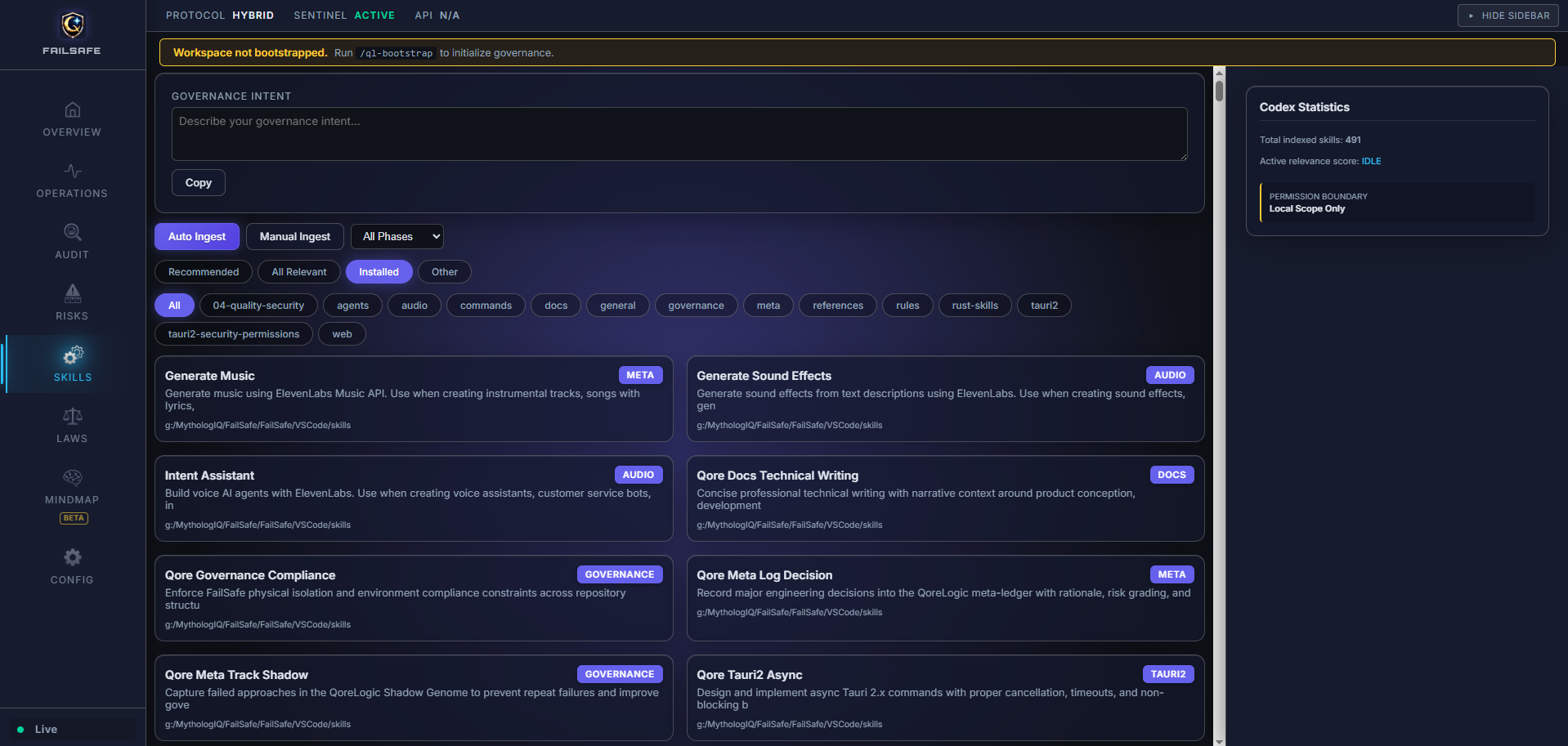
FailSafe is the open-source VS Code and Cursor extension for local AI coding governance — audits, skills, checkpoints, and editor-visible safety workflows. Skills are sourced from the qor-logic PyPI package.
Quick Start | Documentation | VS Code Extension | Open VSX | Roadmap
FailSafe is open source. Fork it, open issues, and submit pull requests.
FailSafe transitioned from beta to stable release on 2026-02-28. We expect even greater things to come Thank you for being part of our journey. See Terms and Conditions.

Create or edit .failsafe/config/policies/risk_grading.json to tune risk classification:
{
  "filePathTriggers": {
    "L3": ["auth", "payment", "credential"]
  },
  "contentTriggers": {
    "L3": ["DROP TABLE", "api_key"]
  }
}
Result: Risk grading overrides are loaded on startup when this JSON file is present. Defaults apply when it is missing. Top-level sections replace defaults, so include full sections if you want to preserve them.
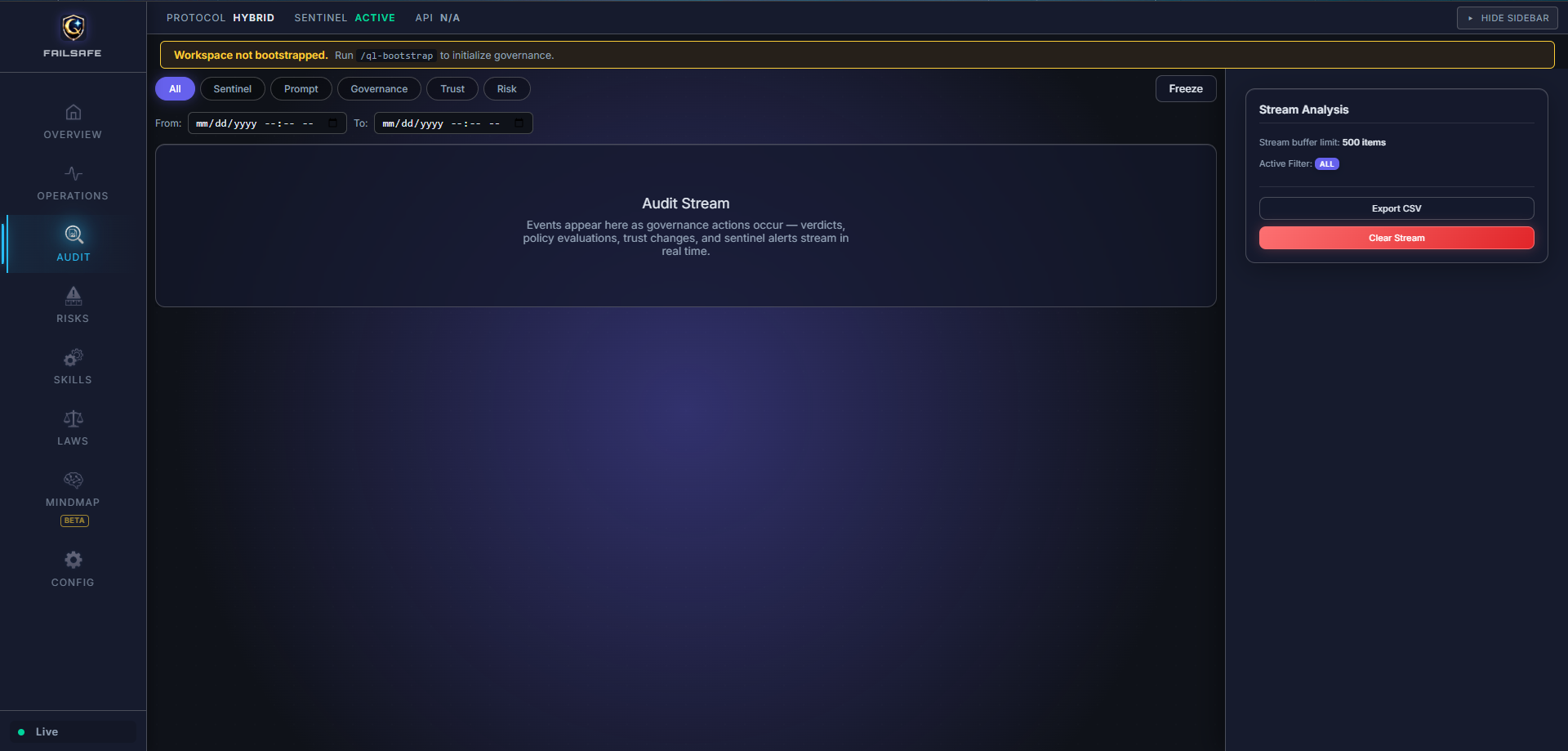
FailSafe is an open-source VS Code extension and stability monitoring framework for AI-assisted development. It adds intent-checked saves (a denied editor save is reported, not prevented: VS Code cannot cancel a save), Sentinel audits, and a ledgered audit trail so risky changes are surfaced and controlled.
FailSafe separates system awareness from system control.
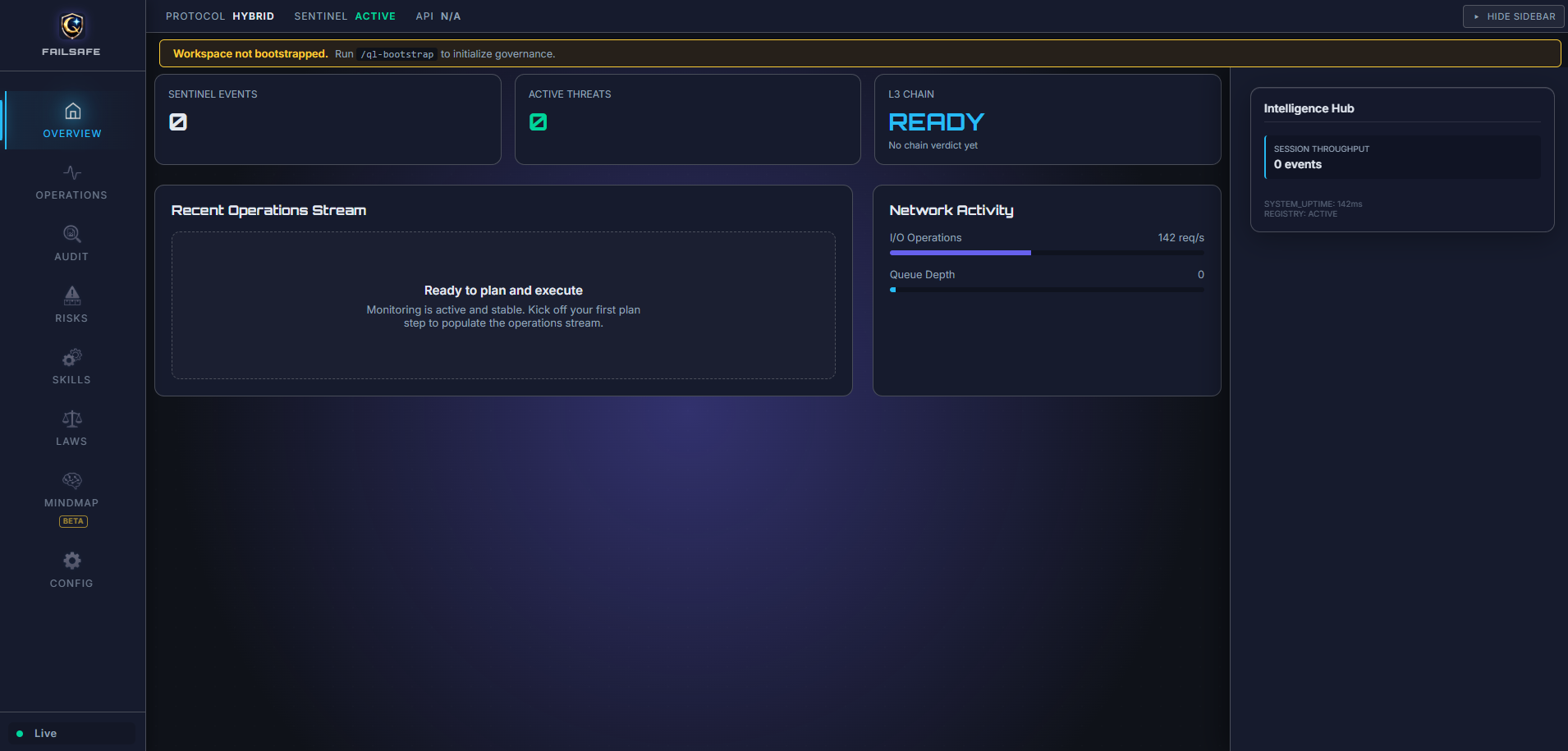
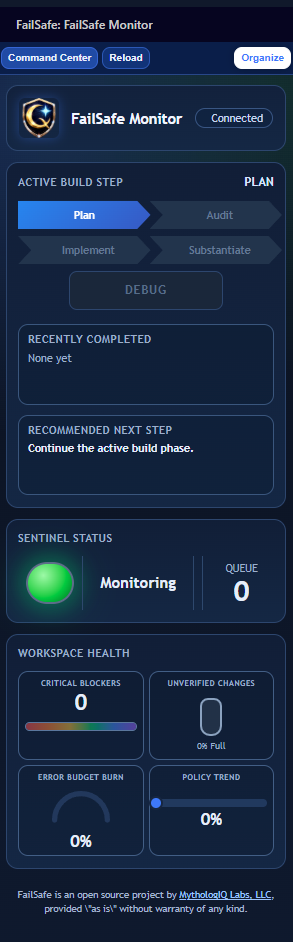
The Monitor provides real-time visibility into system health, governance posture, and operational risk. It is designed for continuous, low-effort awareness.
The Command Center is the primary control surface where teams plan, execute, and govern AI workflows. All configuration, orchestration, and audits originate here.
This separation reduces cognitive load and mirrors real-world operations environments: observe first, act deliberately.
Primary UI surfaces in the current release:
FailSafe Monitor(compact)FailSafe Command Center(extended)
Prompt-based safety asks the LLM to follow rules. The LLM decides whether to comply.
Kernel-style safety evaluates actions at the editor boundary using policies, heuristics, and optional LLM analysis.
graph TD
    A[User Actions] --> B[Intent Service]
    B --> C{Enforcement}
    C -- Allowed --> D[File System]
    C -- Blocked --> E[User Approval]

    F[AI Agent] --> G[MCP Server]
    G --> H[Sentinel Audit]
    H --> I[SOA Ledger]

    I --> J[FailSafe Command Center]
    H --> J
FailSafe uses a Physical Isolation model to separate workspace governance from application development.
/ (root)
+-- .agent/                   # Active workspace workflows
+-- .claude/                  # Active commands + secure tokens
+-- .qorelogic/               # Workspace configuration (locked)
+-- docs/                     # Workspace governance (Ledger, State, Spec)
+-- FAILSAFE_SPECIFICATION.md -> docs/FAILSAFE_SPECIFICATION.md
/FailSafe/ (container)
+-- extension/                # VS Code Extension TypeScript Project
+-- build/                    # Build & validation tooling
Note: A single extension publishes to both VS Code Marketplace and Open VSX via GitHub Actions. Claude Code skills are located at .claude/skills/qor-*/SKILL.md.
| System | Layer | Description |
|---|---|---|
| Genesis | Experience | FailSafe Monitor + FailSafe Command Center |
| Qor-Logic | Governance | Intent gating, policies, ledger, and trust |
| Sentinel | Enforcement | File watcher audits and verdicts |
FailSafe supports three governance modes to match your workflow needs:
| Mode | Behavior | Best For |
|---|---|---|
| Enforce | Default. Full control, intent-checked saves (denials reported, not prevented), L3 approvals. | Governed development, compliance |
| Assist | Smart defaults, auto-intent creation, gentle prompts. | Lighter-touch workflows |
| Observe | No blocking, just visibility and logging. Zero friction. | Exploration, learning |
Enforce is the default mode. Switch modes via the FailSafe: Set Governance Mode command or the failsafe.governance.mode setting.
Qor-Logic is two things working as one: the deterministic governance engine that enforces safety policies at the editor boundary, and the SHIELD skill corpus — sourced from the qor-logic PyPI package — that drives a governed plan → audit → implement → substantiate → deliver lifecycle for AI-assisted work. Both rest on one principle: governance decisions are made by code, not by asking an LLM to follow rules.
| Aspect | Prompt-Based Safety | Qor-Logic Deterministic Governance |
|---|---|---|
| Decision Maker | LLM interprets rules | TypeScript code executes rules |
| Consistency | Varies with context, temperature, model | Identical output for identical input |
| Auditability | Opaque reasoning chain | Explicit code path, logged decisions |
| Bypass Risk | LLM can ignore or reinterpret | Code cannot be persuaded |
| Speed | Network latency + inference | Sub-millisecond local execution |
-
Risk Classification — Files are classified as L1 (low), L2 (medium), or L3 (high) risk based on:
- File path triggers (e.g.,
auth/,payment/,credential→ L3) - Content triggers (e.g.,
DROP TABLE,api_key,private_key→ L3) - Configurable via
.failsafe/config/policies/risk_grading.json
- File path triggers (e.g.,
-
Policy Evaluation — Each risk grade has deterministic requirements:
- L1: Heuristic check, 10% sampling, auto-approve
- L2: Full Sentinel pass, no auto-approve
- L3: Formal verification + human approval required
-
Ledger Recording — Every governance decision is recorded to an append-only SOA ledger with:
- Agent identity and trust score
- Artifact path and risk grade
- Timestamp and decision rationale
-
Trust Dynamics — Agent trust scores evolve based on outcomes:
- Approved L3 actions → trust increase
- Rejected or failed actions → trust decrease
- Trust scores influence future routing decisions
-
Universal Interception — The same deterministic boundary governs more than file edits. Every MCP tool call from a connected integration (Bicameral, Open Design, MCP Catalog servers) is routed through a single
IGovernanceInterceptorseam, so a risky tool invocation is classified, gated, and ledgered exactly like a risky edit. Governance follows the agent wherever it acts.
When an LLM is asked to enforce safety rules, it can:
- Reinterpret rules based on context
- Produce inconsistent decisions across similar inputs
- Be influenced by prompt engineering attacks
Qor-Logic avoids these risks by executing deterministic TypeScript code at the governance boundary. The policy engine uses simple string matching and path analysis—no LLM inference required for governance decisions.
Example: A file containing api_key will always trigger L3 classification. No prompt can persuade the code to ignore this trigger.
| Extension | Description |
|---|---|
| VS Code | Save-time governance, audits, and dashboards |
FailSafe provides governance for multiple AI development environments:
Install the FailSafe extension for real-time governance, audits, and dashboards.
VS Code Marketplace:
ext install MythologIQ.mythologiq-failsafe
Or: https://marketplace.visualstudio.com/items?itemName=MythologIQ.mythologiq-failsafe
Open VSX (VSCodium, Gitpod, etc.):
ext install MythologIQ.mythologiq-failsafe
Or: https://open-vsx.org/extension/MythologIQ/mythologiq-failsafe
Install from Open VSX (VSCodium, Gitpod, Cursor, etc.):
ext install MythologIQ.mythologiq-failsafe
Or: https://open-vsx.org/extension/MythologIQ/mythologiq-failsafe
The Antigravity extension includes:
- Gemini/Antigravity workflows (
.agent/workflows/) - Claude Code skills (
.claude/skills/qor-*/SKILL.md) - Qor-Logic personas (Governor, Judge, Specialist)
- Stability monitoring configuration and skills
Install from VS Code Marketplace:
ext install MythologIQ.mythologiq-failsafe
Or: https://marketplace.visualstudio.com/items?itemName=MythologIQ.mythologiq-failsafe
The VSCode extension includes:
- Copilot prompt files (
.github/prompts/) - Claude Code skills (
.claude/skills/qor-*/SKILL.md) - Agent personas (
.github/copilot-instructions/) - Stability monitoring configuration and skills
Both extensions include Claude Code slash commands that map to the physical SHIELD governance lifecycle:
- S - SECURE INTENT (
/qor-bootstrap): Seed project DNA. Document the Why, encode the architecture, initialize the Merkle chain. - H - HYPOTHESIZE (
/qor-plan): Create implementation blueprints with risk grades, file contracts, and Section 4 complexity limits. - I - INTERROGATE (
/qor-audit): Adversarial tribunal. The Judge audits the plan for security, correctness, and drift. PASS or VETO. - E - EXECUTE (
/qor-implement): Build under KISS constraints after a PASS verdict. Functions under 40 lines. Nesting under 3 levels. - L - LOCK PROOF (
/qor-substantiate): Verify Reality matches Promise. Cryptographically seal the session with Merkle hash verification. - D - DELIVER (
/qor-release): Deploy, inspect packaged artifacts before publish, hand off with traceability, and monitor for operational drift.
# Run FailSafe locally
cd FailSafe/extension
npm install
npm run compile
We'd love your review! If FailSafe is useful to you, please leave a review on the VS Code Marketplace or Open VSX. Your feedback helps other developers discover FailSafe and directly shapes its roadmap. Bug reports and feature requests welcome on GitHub Issues.
- CI/CD Pipeline Enforcer: Headless Judge verification validating
failsafe_checkpointsvia cryptography during PRs. - Shared "Core Axioms": IDE startup synchronization of enterprise-level Policy and Axioms to enforce team-wide Q-DNA compliance.
- Air-Gapped Judge Verification: Support for routing L3 architectural audits to local LLMs (Ollama, LM Studio, etc.) for zero-leak compliance.
- CLI Overseer Lite: Lightweight CLI-compatible FailSafe for direct website integration.
FailSafe is a stable release. While we strive for reliability and completeness, all software carries inherent risks.
FailSafe is provided "as is" without warranties of any kind, express or implied. While we have made every effort to ensure the software's reliability and security, you acknowledge that you use this software at your own risk.
By using FailSafe, you agree to the following:
-
Use at Your Own Risk: FailSafe is designed to assist with debugging and stability monitoring for AI-assisted development, but it cannot guarantee complete protection against all risks. You remain responsible for reviewing and validating all AI-generated code and decisions.
-
No Warranty: MythologIQ provides no warranties, express or implied, including but not limited to warranties of merchantability, fitness for a particular purpose, or non-infringement.
-
Limitation of Liability: MythologIQ shall not be liable for any direct, indirect, incidental, special, consequential, or punitive damages arising from use of FailSafe, including but not limited to loss of data, downtime, business interruption, or any other damages.
-
Data Backups: You are responsible for maintaining appropriate backups of your work. FailSafe includes governance and checkpoint features, but these do not replace proper backup practices.
-
Compliance: You are responsible for ensuring your use of FailSafe complies with applicable laws, regulations, and organizational policies.
-
Updates and Changes: FailSafe may receive updates that include new features, bug fixes, or changes to existing functionality. You are responsible for reviewing release notes and understanding how updates may affect your workflow.
-
Feedback and Contributions: We welcome feedback, bug reports, and contributions. By contributing, you agree to license your contributions under the project's Apache License 2.0.
Thank you for being part of our journey. Your trust and feedback help us improve FailSafe for everyone.
git clone https://github.com/MythologIQ/FailSafe.git
cd FailSafe
npm installApache License 2.0 - See LICENSE
FailSafe tracks more than Git state. It records governance checkpoints as signed metadata records, then stores Sentinel observations in a local retrieval store so operators can recover the what, why, and how of runtime decisions.
- Git readiness is checked at bootstrap (
ensureGitRepositoryReady). FailSafe asks before runninggit initin a folder without a repository, and installs Git only whenfailsafe.bootstrap.autoInstallGitis turned on. - Governance events are checkpointed into
failsafe_checkpointswith run/phase/status context and deterministic hashes. - Each checkpoint carries
git_hash,payload_hash,entry_hash, andprev_hashso chain integrity can be recomputed. - Hub and API surfaces expose both summary and recent checkpoint records for operational visibility.
- Sentinel writes local memory records to
.failsafe/rag/sentinel-rag.db(or JSONL fallback), includingpayload_json,metadata_json, and retrieval text.
- Tamper evidence via hash-chained checkpoint records.
- Git-linked governance state for repository-correlated audit trails.
- Local-first memory retention for security and low-latency recall.
- Deterministic fallback paths when SQLite is unavailable.
| Claim | Status | Source |
|---|---|---|
Checkpoints persist in failsafe_checkpoints with typed governance fields. |
implemented | FailSafe/extension/src/roadmap/RoadmapServer.ts |
Checkpoint records include hash-chain material (payload_hash, entry_hash, prev_hash). |
implemented | FailSafe/extension/src/roadmap/RoadmapServer.ts |
| Each checkpoint captures current Git head/hash context. | implemented | FailSafe/extension/src/roadmap/RoadmapServer.ts |
| Checkpoint history and chain validity are exposed over API. | implemented | FailSafe/extension/src/roadmap/RoadmapServer.ts |
Hub snapshot includes checkpointSummary and recentCheckpoints. |
implemented | FailSafe/extension/src/roadmap/RoadmapServer.ts |
| Sentinel local RAG persists observation payload + metadata + retrieval text. | implemented | FailSafe/extension/src/sentinel/SentinelRagStore.ts |
| Sentinel RAG can fall back to JSONL when SQLite is unavailable. | implemented | FailSafe/extension/src/sentinel/SentinelRagStore.ts |
RAG writes are controlled by failsafe.sentinel.ragEnabled (default true). |
implemented | FailSafe/extension/src/sentinel/SentinelDaemon.ts |
| Checkpoint and Sentinel RAG tables are independent (no foreign-key link). | false | Confirmed: failsafe_checkpoints (ledger DB) and sentinel_observations (RAG DB) are in separate databases with no shared keys. evidenceRefs is always []. |