

English | 한국어 · PyPI · License
Connecting Nuclear Fusion Knowledge Across Domains for Integrated Tokamak Research
VAFT is a scientific framework for organizing and analyzing tokamak data using IMAS structures. It connects experimental data, reconstructed plasma states, simulation results, and analysis workflows through shared data structures and recorded processing history.
VAFT maps device-specific diagnostics and machine data into the common data model defined by the IMAS Data Dictionary. OMAS provides a Python interface to those structures. VAFT uses the standardized records for processing and visualization and to exchange data with established physics codes such as EFIT and CHEASE. Native diagnostic files and solver outputs remain available alongside those records.
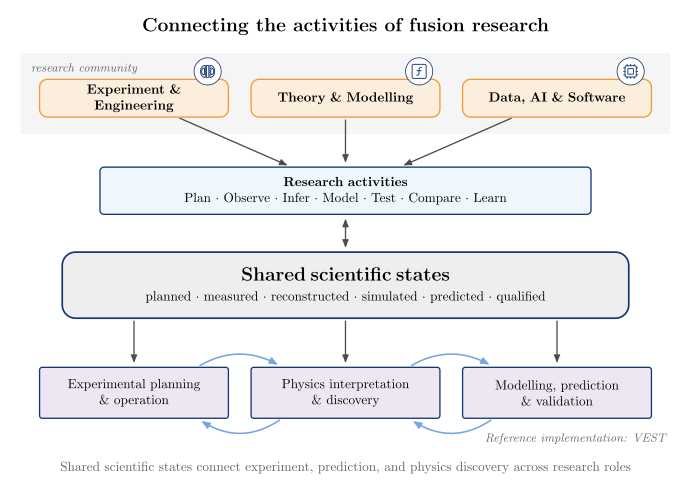
The diagram places experiments, theory and modeling, and data-driven studies around measured, reconstructed, and simulated plasma states. VAFT lets researchers exchange and compare those states without replacing their specialized physics codes.
Explore the diagram and its detailed version. The domains VAFT connects, research modes such as experiment, theory, modelling and AI/ML across physics domains such as equilibrium, stability and transport, are defined on Research domains.
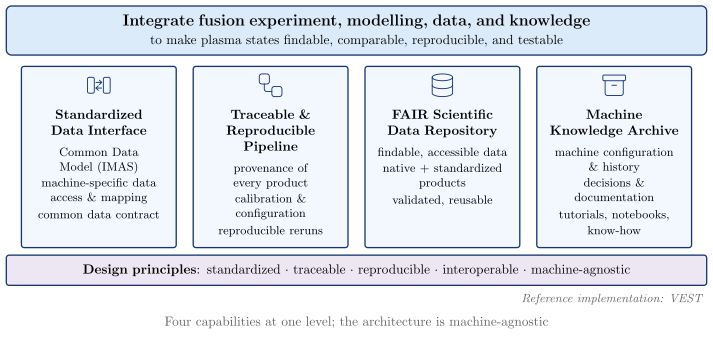
These four capabilities work together rather than as successive stages. IMAS mappings provide a common interface; recorded configurations make processing traceable; and the repository and archive retain the data and machine context needed to interpret a result. For researchers, they address four practical needs:
- Representation: map diagnostic channels, device geometry, equilibria, and profiles to named IMAS structures while retaining source and flux conventions.
- Research infrastructure: keep native files and standardized shot records accessible, alongside notebooks and device configuration history.
- Credibility: record calibrations, mapping versions, solver settings, and quality checks so workflows are traceable and reproducible and results are verifiable.
- Research practice and portability: use the same data paths for reconstruction, modeling, and plotting; adapt those workflows to another device by supplying its mappings.
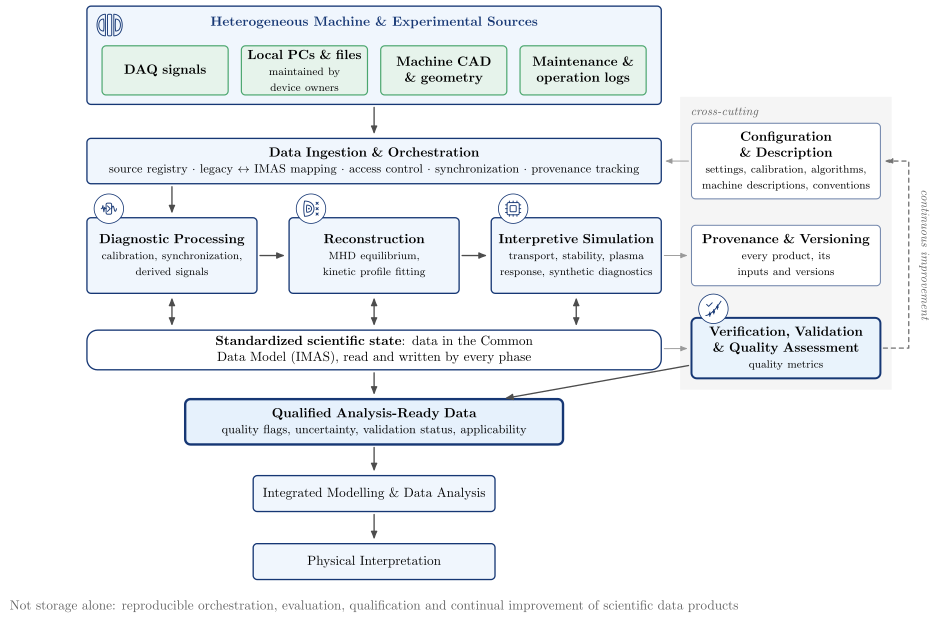
Machine descriptions and diagnostic measurements are registered and mapped to IMAS data structures. Diagnostic processing, equilibrium reconstruction, and simulation read and write those structures; the workflow records configurations and provenance and checks data quality before results are reused in analysis.
Start with offline sample data, then explore shots and diagnostics or reconstruct equilibria and fit profiles. The research notebooks and workflow guide show complete examples.
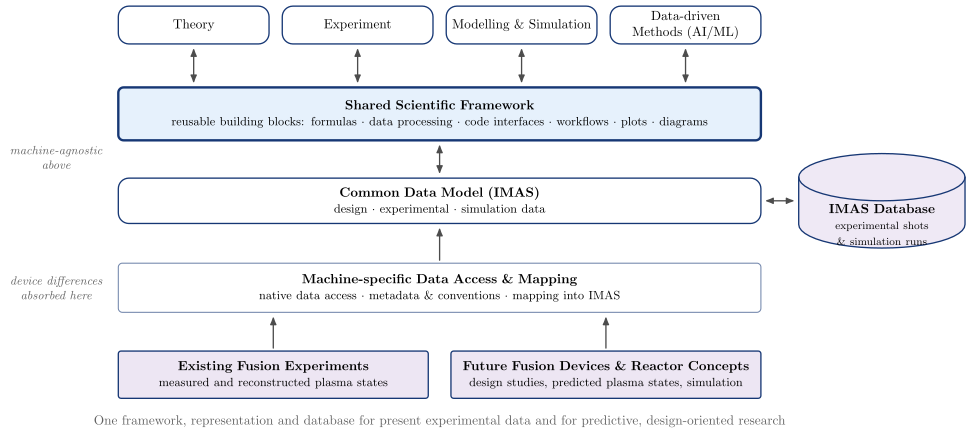
The architecture separates device-specific data access and mapping from the common IMAS data model and the analysis tools above it. Connecting another device requires its own data access and mappings.
The VEST tokamak at Seoul National University provides the concrete reference implementation. The diagram follows one shot from VEST through experimental data processing into a per-shot database.
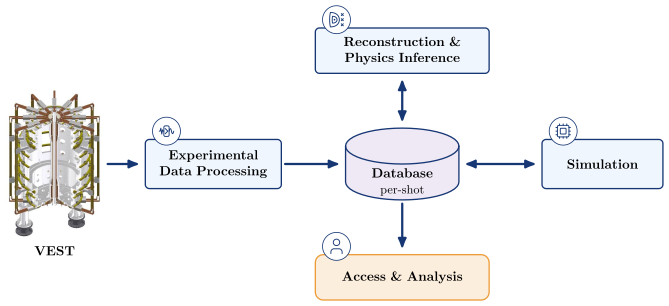
Reconstruction and physics inference, as well as simulation, read from and write to that database. VAFT provides access and analysis below it; the detailed VEST platform diagram shows the processing and research components inside each stage.
Install the published package, then inspect the packaged VEST sample without database credentials or external fusion codes:
pip install vaftimport vaft
ods = vaft.omas.sample_ods()
print(sorted(ods.keys()))For a plotted first result, follow Start here. For source installation or platform setup, see install/README.md.