




Install · Use · Results · How it works · Limitations · Training · Roadmap · Citation
Text-to-satellite-image diffusion, packaged. rsdiff is the reference implementation of RSDiff (Neural Computing and Applications, 2024): a T5-conditioned, Imagen-style cascaded diffusion model that turns a caption such as "many buildings and green trees are around a playground ." into a 256x256 synthetic remote-sensing image. One command downloads the released RSICD-trained checkpoint, verifies it, and samples; a second scores the result with the same FID and CLIP-score protocol used for the published numbers (FID 65.70, CLIP-score 0.278 on the full RSICD test split).
Every image rsdiff produces is synthetic. It is not an observation or a prediction of any real place, and each PNG says so in its metadata.
pip install rsdiff            # sampling + CLIP-score
pip install "rsdiff[eval]"    # adds torchmetrics for FID
Python 3.10+. Sampling runs on CUDA when available and otherwise on CPU. Apple MPS is not supported: imagen-pytorch 2.1.0 and the torchmetrics FID both use float64.
Generate images from your own captions. The first run downloads the released checkpoint (1.9 GB, pinned Hugging Face revision) and verifies its SHA-256:
rsdiff sample --prompt "many buildings and green trees are around a playground ." -n 4 --out-dir generatedThis writes 256x256 PNGs and a captions.txt to generated/. --prompt can be
repeated. Each PNG carries Software, Description (a synthetic-content notice), and
Prompt text chunks.
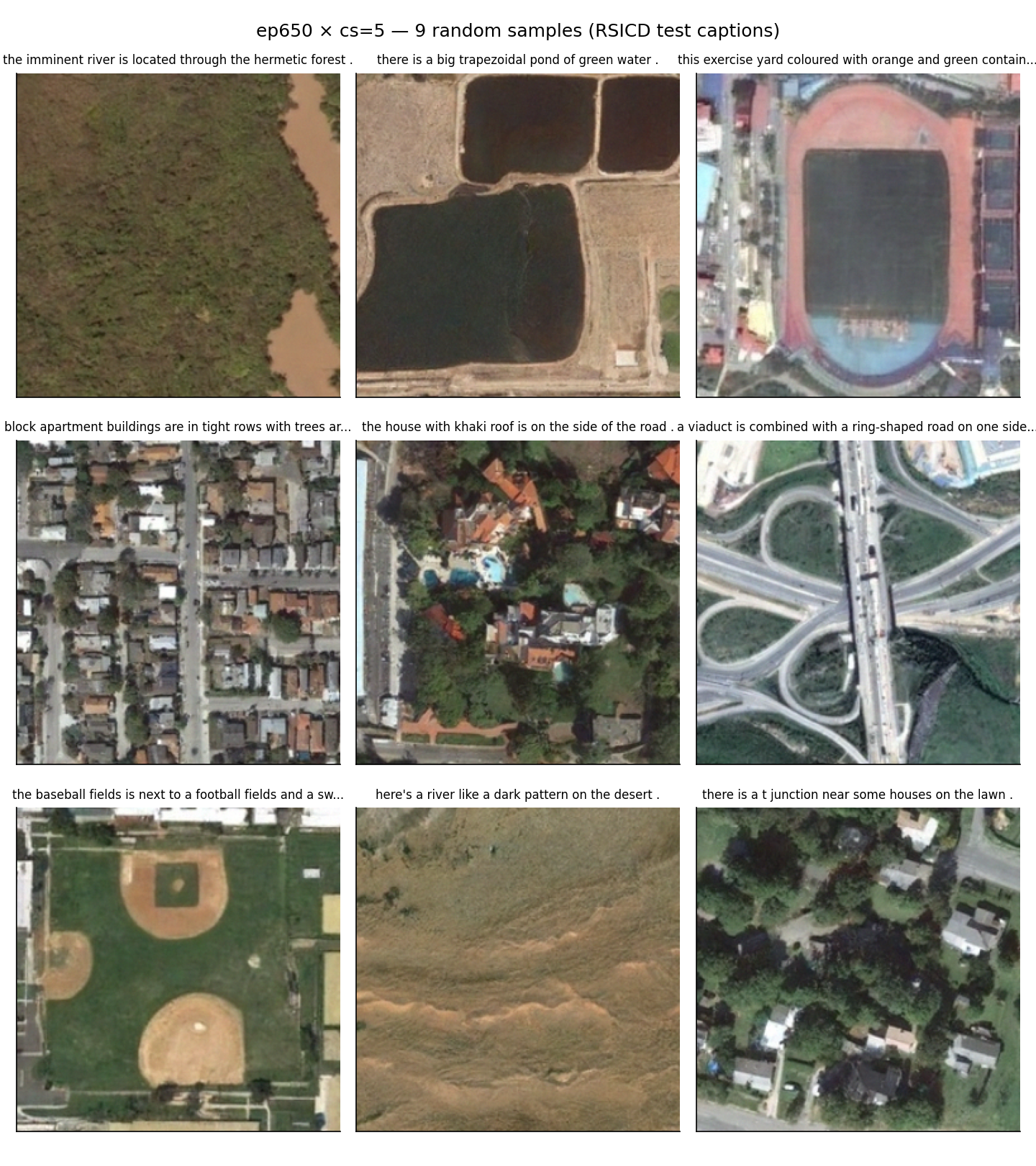
Or draw captions from RSICD (first caption, sent1, shuffled with --seed, default 17):
rsdiff sample --rsicd data/RSICD_optimal --split test -n 16 --out-dir generatedUseful options: --cond-scale (default 5), --batch-size (default 2), --lr-only
(stop at the 128x128 base stage), --cpu, --config rsdiff1.5|rsdiff1|path.yaml, and
--checkpoint PATH (required for non-default configs). An interrupted run resumes:
batches whose PNGs already exist are skipped.
Score a generated directory against the RSICD test split:
rsdiff eval fid generated --rsicd data/RSICD_optimal    # --feature 2048 --size 256 by default
rsdiff eval clip generated                             # clip_score, clip_score_shuffled, delta
Both print JSON. The same pieces are available from Python:
from rsdiff.cascade import download_release, generate, load_cascade
from rsdiff.config import load_preset
from rsdiff.eval import clip_score

cfg = load_preset("rsdiff1.5")
trainer = load_cascade(cfg, download_release())
paths = generate(trainer.sample, ["a river runs through the green farmland ."], "generated")
print(clip_score("generated"))
rsdiff.datasets.rsicd.sample_captions reproduces the CLI's RSICD caption draw, and
rsdiff.eval.fid computes FID.
Released checkpoint, full RSICD test split (N=1,093), cascade output at 256x256,
cond_scale=5:
| Metric | Value |
|---|---|
| FID (torchmetrics Inception, feature 2048, both sides at 256) | 65.70 |
| CLIP-score (OpenAI CLIP ViT-B/32) | 0.278 |
| CLIP-score, shuffled-caption baseline | 0.232 |
| Parameters (base UNet 27.2 M + SR UNet 92.7 M) | 119.9 M1 |
The CLIP-score sits 0.046 above the shuffled-caption baseline: the images follow their captions, not just the RSICD domain.
| Curve | Figure |
|---|---|
| SR FID versus epoch (ep150 to ep1000) | docs/figures/sr_fid_curve.png |
CFG cond_scale sweep on the selected SR milestone |
docs/figures/cfg_sweep.png |
| LR base FID versus epoch | docs/figures/lr_fid_curve.png |


The numbers behind every figure are committed in results/. Methodology and
discussion: docs/REPORT.md. Model card:
docs/model_card.md.
- A frozen T5-base encoder turns the caption into token embeddings.
- A 128x128 base UNet denoises from noise over 1,000 DDPM steps, cross-attending to the text.
- A 256x256 super-resolution UNet denoises again, conditioned on the text and the upsampled base image.
Both stages use classifier-free guidance (trained with 10% caption dropout) with a shared
cond_scale; 5 is the value selected by the CFG sweep and used for every headline
number. Sampling uses the EMA weights of the merged epoch-650 checkpoint. The presets
ship inside the package: rsdiff1.5 (released) and
rsdiff1 (the 723 M paper configuration; weights not
released).
- Synthetic only. Outputs are plausible-looking imagery, not observed or predicted geography. Do not use them as evidence about a real location.
- RSICD domain. The model was trained on the 30 RSICD scene types and their short, lowercase captions. Prompts unlike those captions have not been evaluated.
- 256 px. The cascade stops at 256x256.
- No Apple MPS. float64 operations in imagen-pytorch 2.1.0 and torchmetrics FID are not supported on MPS.
- CPU sampling is slow. 2,000 denoising steps per image took about an hour on an Apple-silicon CPU; use a CUDA GPU for more than a handful of images.
- Weights not commercially cleared. RSICD's commercial terms are unresolved; see
docs/LICENSE_AUDIT.md.
Training runs through the original training code in ddpm/:
bash ddpm/scripts/run_training_local.sh   # stage 1: 128x128 base UNet
bash ddpm/scripts/run_sr.sh               # stage 2: 256x256 SR UNet on the frozen base
docs/reproducibility.md is the complete runbook: environment,
dataset preparation, training, milestone sweeps, sampling the 1,093-image bundle, and
scoring.
- Commercial relevance. Test whether synthetic augmentation improves a downstream model on an untouched real-data test set.
- Training in the package. Move the two-stage training loop out of
ddpm/intorsdiff.
Details and acceptance criteria: docs/PLAN.md.
@article{sebaq2024rsdiff,
  title   = {RSDiff: remote sensing image generation from text using diffusion model},
  author  = {Sebaq, Ahmad and ElHelw, Mohamed},
  journal = {Neural Computing and Applications},
  volume  = {36},
  number  = {36},
  pages   = {23103--23111},
  year    = {2024},
  doi     = {10.1007/s00521-024-10363-3}
}Code: Apache-2.0, see LICENSE and NOTICE. The released weights
were trained on RSICD, whose commercial terms are unresolved; dataset, dependency, and
derived-weight rights are tracked in docs/LICENSE_AUDIT.md.
Built on lucidrains/imagen-pytorch;
developed at the Center for Informatics Science, Nile University.
Footnotes
-
119.9 M counts the two standalone UNets, as in the paper and model card. Loaded inside the cascade, the SR UNet gains low-resolution conditioning layers (105.0 M), so the cascade holds 132.2 M trainable parameters, plus the frozen T5-base text encoder. ↩