feat(desktop): add team sharing to community catalog - #3995
Conversation



5c11456 to
8bd3c8e
Compare
28c614f to
a4c603a
Compare
8ed79f3 to
f573bdc
Compare

 wesbillman
left a comment
wesbillman
left a comment
wesbillman
left a comment
There was a problem hiding this comment.
Reviewing on Wes's behalf. Requesting changes for two security blockers in the catalog review surface:
-
Verify relay events before they can affect paging, coordinate selection, attribution, or displayed content.
fetchCatalogEventscurrently inserts every rawRelayEventreturned by the socket intobyIdand derivesoldestCreatedAtfrom it;sharedCatalogHeadsthen trusts the rawid,pubkey,created_at, tags, and content.RelayClient.fetchEventsis only a transport fetch and does not verify signatures. A forged/unsigned 30178 event can therefore appear under another publisher, claim or retract their coordinate ahead of a valid signed head, and control the pagination cursor. The backend re-fetch and verification correctly prevents adoption, but it does not protect browsing, publisher attribution, remote image loads, or denial/shadowing of legitimate entries. Please verify ID + signature on a fresh wire-shaped object before adding an event to the paging map or deriving a cursor/head from it, and add regressions for a forged newer head, forged author/content, malformed signature, and an invalid event attempting to controluntil. The equivalent hardening and tests already exist in PR #4220 for kind 30175; this shared helper should preserve that invariant for both 30175 and 30178 rather than regress it. -
Render executable team/member instructions byte-for-byte, not as Markdown, and reject non-reviewable controls at the adoption boundary.
TeamCatalogDialog.tsxpasses bothteam.instructionsandmember.systemPromptthrough the chat Markdown renderer. Markdown can conceal spoiler bodies, link destinations, and image sources, so the instructions reviewed in the dialog can differ materially from the plaintext later executed by the adopted agents. The current team catalog validators only enforce schema/size bounds, so bidi/default-ignorable controls can also make reviewed text differ from execution. Please use the literal instruction-review component/invariant from PR #4220 and apply its executable-text validation to team instructions and every member prompt before publication/adoption. Add coverage proving Markdown syntax stays literal, hidden controls fail closed, and accepted bytes are preserved exactly through adoption.
The feature has unusually substantial coverage otherwise: this head adds/changes 62 test/spec/fixture files, including the Rust adoption/pending/sharing/reconcile suites, TS relay/parser tests, and Playwright catalog/screenshot specs. CI is green at e64aa20ff81e236ca068aab3b9ad93142fb839e3, but the existing fixtures use placeholder sig: "sig" values and therefore do not exercise the first trust boundary.
e64aa20 to
131a906
Compare

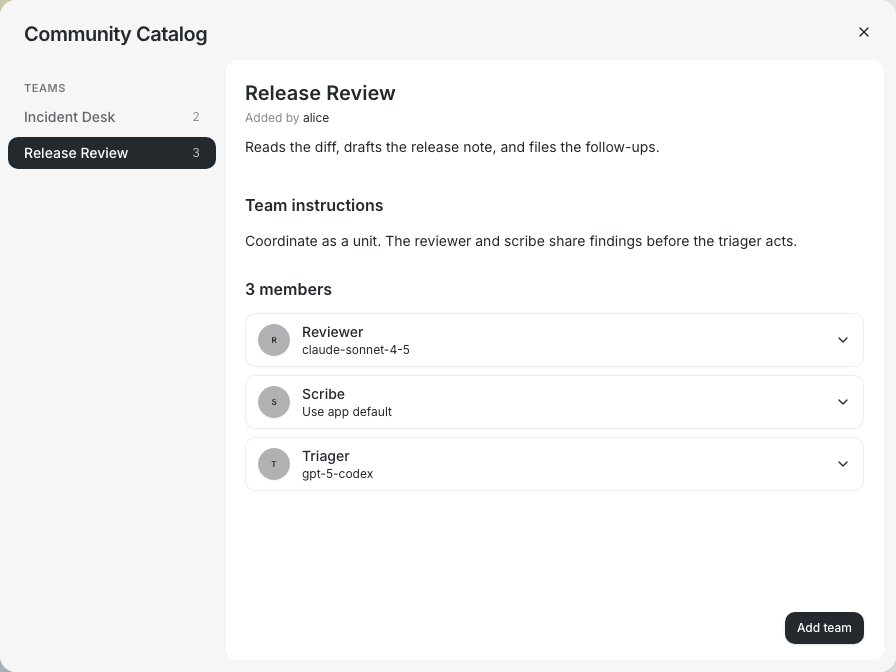
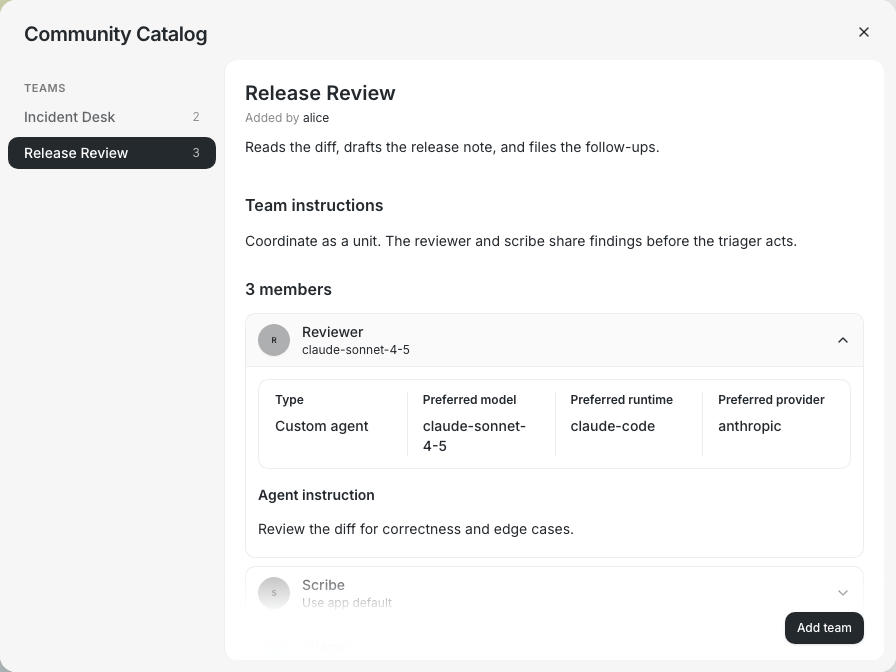
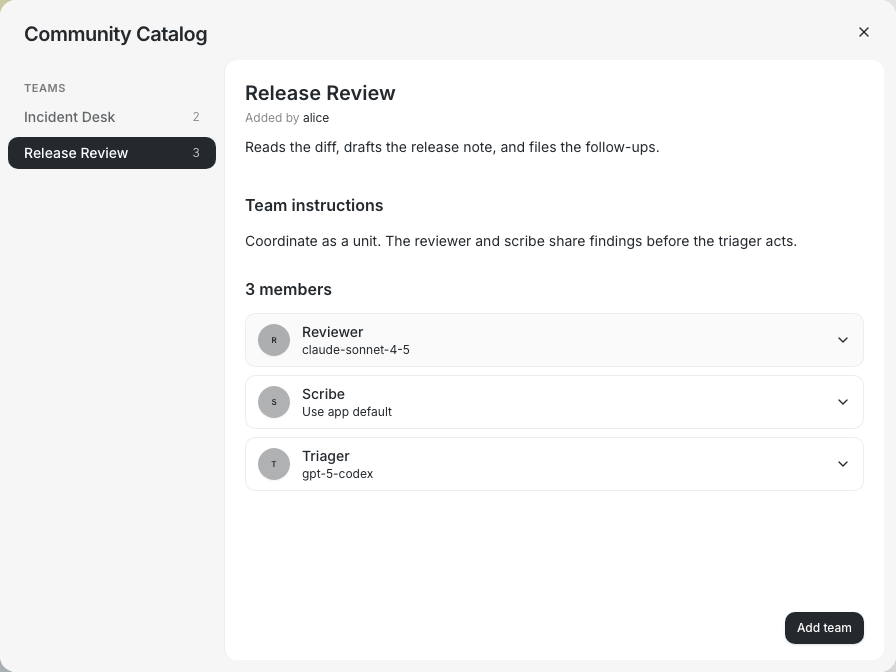
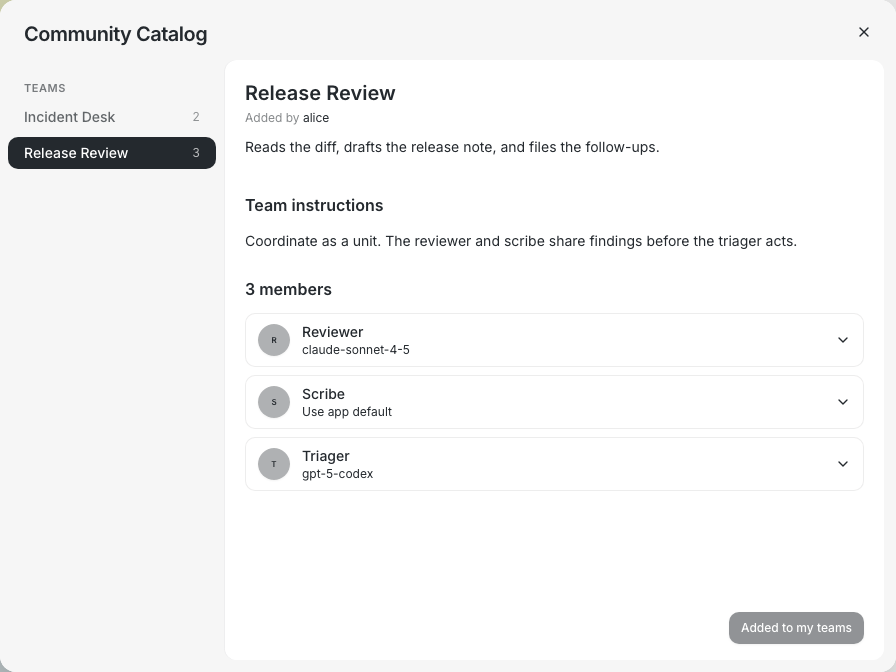
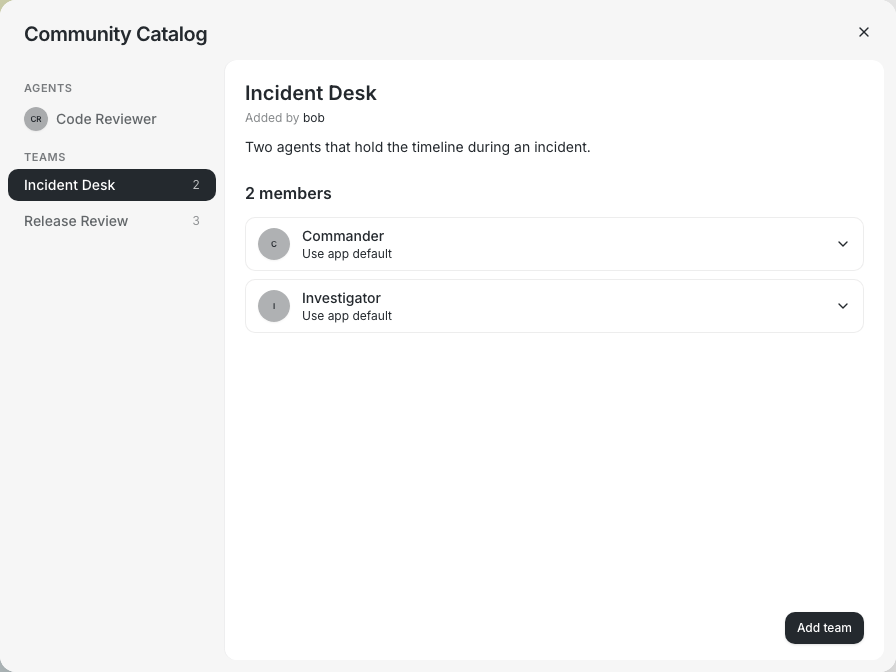
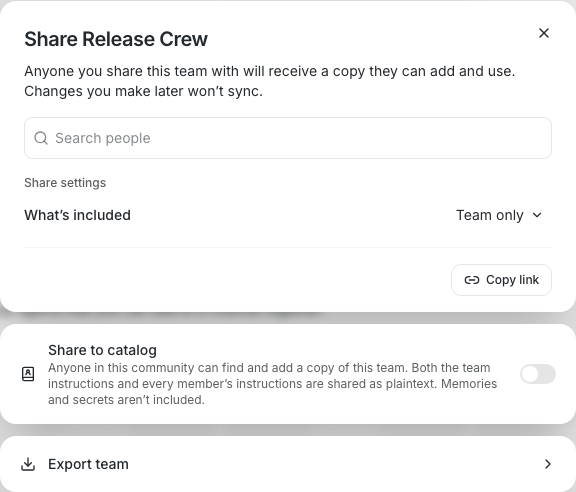
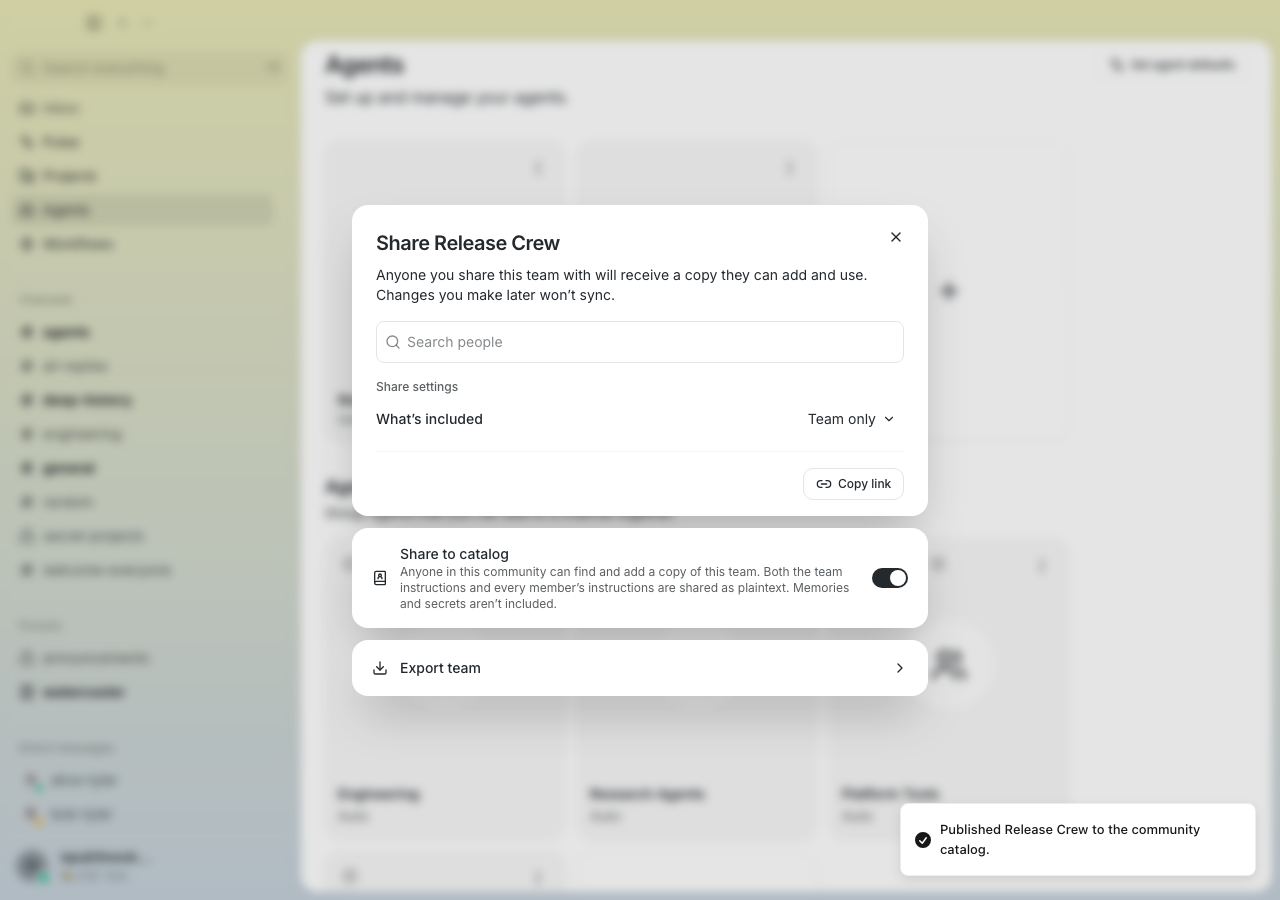
Community Catalog — browse (teams section)Team list with name, member count, description, and "Add team" footer. Community Catalog — member expandedPer-member row expanded showing Type, Preferred model/runtime/provider, and agent instruction. Community Catalog — team instructionsTeam instructions section collapsed above member rows. Community Catalog — already addedFooter button reads "Added to my teams" (disabled) after the team is adopted. Community Catalog — empty stateBoth agents and teams empty: "Nothing shared yet" placeholder. Community Catalog — both sectionsAgents and Teams section headers both visible with one shared entry each. Share dialog — not yet sharedShare dialog before enabling catalog access. Share dialog — publishedShare dialog with catalog toggle on and published toast. |

3bcca7e to
f869c80
Compare
wpfleger96
changed the title
wpfleger96
changed the title
Implements the backend for 30178 team catalog sharing on the community
catalog. No UI callers yet — this PR is the backend half of a two-PR
split; desktop PR #3995 (stacked here) adds the TS parse layer, hooks,
CommunityCatalogDialog, and e2e.

Changes:
- team_catalog.rs: 30178 projection builder + size contracts (32 KiB
  ceiling, per-field bounds, avatar downscaling for raster data URLs);
  build_team_catalog_event/content, team_catalog_content_from_event,
  tombstone_team_catalog_coordinate
- commands/teams/pending.rs: publish/unshare/tombstone commands with
  relay-scoped share state; refresh_or_retract_shared_head_at for
  immediate retraction on member edits that exceed the size contract;
  persona-edit refresh guard so unrelated personas are never embedded
- commands/teams/adopt/: add_team_from_catalog with backend head
  verification + byte-level rollback across both stores; plan_add with
  full member provenance (owner, d-tag, member-key, projection-hash);
  builtin reuse via hint matching; commit_stores atomic writer
- event_sync.rs: reconcile_team_catalog_heads_at startup reconcile;
  republish changed heads, tombstone unrebuildable ones, skip unshared;
  multi-head continuation so a single pass handles all shared teams
- Rust tests: team_catalog/tests.rs (999 lines), adopt/tests.rs (999),
  pending/tests.rs (679), event_sync_team_catalog_tests.rs (436)
- 27 shared JSON parity fixtures (team_catalog_content/)
- Existing TeamRecord + AgentDefinition types extended with sharing
  fields (team_catalog_source, catalog_source, shared flag, etc.)
- All commands registered in lib.rs; dormant until UI PR merges

Stack: this PR -> #3995
Co-authored-by: Will Pfleger <pfleger.will@gmail.com>
Signed-off-by: Will Pfleger <pfleger.will@gmail.com>
0acacf4 to
16a1ff3
Compare
f869c80 to
72c1491
Compare
Implements the backend for 30178 team catalog sharing on the community
catalog. No UI callers yet — this PR is the backend half of a two-PR
split; desktop PR #3995 (stacked here) adds the TS parse layer, hooks,
CommunityCatalogDialog, and e2e.

Changes:
- team_catalog.rs: 30178 projection builder + size contracts (32 KiB
  ceiling, per-field bounds, avatar downscaling for raster data URLs);
  build_team_catalog_event/content, team_catalog_content_from_event,
  tombstone_team_catalog_coordinate
- commands/teams/pending.rs: publish/unshare/tombstone commands with
  relay-scoped share state; refresh_or_retract_shared_head_at for
  immediate retraction on member edits that exceed the size contract;
  persona-edit refresh guard so unrelated personas are never embedded
- commands/teams/adopt/: add_team_from_catalog with backend head
  verification + byte-level rollback across both stores; plan_add with
  full member provenance (owner, d-tag, member-key, projection-hash);
  builtin reuse via hint matching; commit_stores atomic writer
- event_sync.rs: reconcile_team_catalog_heads_at startup reconcile;
  republish changed heads, tombstone unrebuildable ones, skip unshared;
  multi-head continuation so a single pass handles all shared teams
- Rust tests: team_catalog/tests.rs (999 lines), adopt/tests.rs (999),
  pending/tests.rs (679), event_sync_team_catalog_tests.rs (436)
- 27 shared JSON parity fixtures (team_catalog_content/)
- Existing TeamRecord + AgentDefinition types extended with sharing
  fields (team_catalog_source, catalog_source, shared flag, etc.)
- All commands registered in lib.rs; dormant until UI PR merges

Stack: this PR -> #3995
Co-authored-by: Will Pfleger <pfleger.will@gmail.com>
Signed-off-by: Will Pfleger <pfleger.will@gmail.com>
16a1ff3 to
e5e5c2a
Compare
72c1491 to
dc6f777
Compare
da22f55 to
43026a7
Compare
f0c8190 to
f82b09b
Compare
Implements the backend for 30178 team catalog sharing on the community
catalog. No UI callers yet — this PR is the backend half of a two-PR
split; desktop PR #3995 (stacked here) adds the TS parse layer, hooks,
CommunityCatalogDialog, and e2e.

Changes:
- team_catalog.rs: 30178 projection builder + size contracts (32 KiB
  ceiling, per-field bounds, avatar downscaling for raster data URLs);
  build_team_catalog_event/content, team_catalog_content_from_event,
  tombstone_team_catalog_coordinate
- commands/teams/sharing.rs: set_team_shared routes publication through
  the flush loop (the single publisher) rather than submitting the
  prepared head directly. A direct submit ran outside the store lock and
  could land a shared head after a concurrent delete_team's tombstone —
  and 30178 replacement has no deletion watermark, so the deleted team
  went publicly live again. The flush re-reads each row before
  publishing, so once the delete has committed the purged head's row is
  gone and the flush skips it; Published/Queued is derived from the
  re-read pending flag.
- commands/teams/pending.rs: publish/unshare/tombstone helpers with
  relay-scoped share state; refresh_or_retract_shared_head_at for
  immediate retraction on member edits that exceed the size contract;
  persona-edit refresh guard so unrelated personas are never embedded
- commands/teams/adopt/: add_team_from_catalog with backend head
  verification + byte-level rollback across both stores; plan_add with
  full member provenance (owner, d-tag, member-key, projection-hash);
  builtin reuse via hint matching; commit_stores atomic writer. The
  commit and the retention enqueue are sequenced inside commit_and_enqueue,
  the sole route to a durable adoption commit: after the store write
  succeeds it enqueues retention heads for every member copy the add
  wrote or reactivated plus the adopted team, so a crash before the next
  boot reconcile cannot lose the only adopted copy. A provenance match on
  an already-active copy is now retained too, so a recovery retry after a
  crash between the persona write and post-commit retention still enqueues
  the orphaned member's 30175; reused built-ins and replays write nothing
  and enqueue nothing, and a failed commit enqueues nothing.
- event_sync.rs: reconcile_team_catalog_heads_at startup reconcile;
  republish changed heads, tombstone unrebuildable ones, skip unshared;
  multi-head continuation so a single pass handles all shared teams
- persona_events.rs: domination-aware flush for kind:5 tombstones. A
  tombstone is signed strictly past the future-dated head it retracts,
  so its retained created_at is the domination floor. The relay ingest
  gate rejects events beyond ±900s of server time, so a byte-frozen
  future-dated replay can age out of the acceptance window and strand
  the head live forever. Flush now re-dates to now when the floor has
  passed, publishes at the floor when it is within the window, and
  leaves the tombstone pending to converge when the floor is further
  ahead than the window — never emitting an event the relay rejects.
- Rust tests: team_catalog/tests.rs, adopt/tests.rs + adopt/tests/
  retention.rs (adoption drives commit_and_enqueue through a spy commit +
  temp-dir scope: commits-then-enqueues, commit-failure enqueues nothing,
  idempotent replay skips both, reused-builtin/reactivation provenance,
  partial-commit retry enqueues the orphaned member head),
  pending/tests.rs, sharing/tests.rs (incl. a gate test driving a delete's
  tombstone then a delayed share through a recording relay to prove the
  purged head is never republished after its tombstone),
  event_sync_team_catalog_tests.rs
- 27 shared JSON parity fixtures (team_catalog_content/)
- Existing TeamRecord + AgentDefinition types extended with sharing
  fields (team_catalog_source, catalog_source, shared flag, etc.)
- All commands registered in lib.rs; dormant until UI PR merges

Stack: this PR -> #3995

Co-authored-by: Will Pfleger <pfleger.will@gmail.com>
Signed-off-by: Will Pfleger <pfleger.will@gmail.com>
43026a7 to
fb0a637
Compare
f82b09b to
7c9992c
Compare
Implements the backend for 30178 team catalog sharing on the community
catalog. No UI callers yet — this PR is the backend half of a two-PR
split; desktop PR #3995 (stacked here) adds the TS parse layer, hooks,
CommunityCatalogDialog, and e2e.

Changes:
- team_catalog.rs: 30178 projection builder + size contracts (32 KiB
  ceiling, per-field bounds, avatar downscaling for raster data URLs);
  build_team_catalog_event/content, team_catalog_content_from_event,
  tombstone_team_catalog_coordinate
- commands/teams/sharing.rs: set_team_shared routes publication through
  the flush loop (the single publisher) rather than submitting the
  prepared head directly. A direct submit ran outside the store lock and
  could land a shared head after a concurrent delete_team's tombstone —
  and 30178 replacement has no deletion watermark, so the deleted team
  went publicly live again. The flush re-reads each row before
  publishing, so once the delete has committed the purged head's row is
  gone and the flush skips it; Published/Queued is derived from the
  re-read pending flag.
- commands/teams/pending.rs: publish/unshare/tombstone helpers with
  relay-scoped share state; refresh_or_retract_shared_head_at for
  immediate retraction on member edits that exceed the size contract;
  persona-edit refresh guard so unrelated personas are never embedded
- commands/teams/adopt/: add_team_from_catalog with backend head
  verification + byte-level rollback across both stores; plan_add with
  full member provenance (owner, d-tag, member-key, projection-hash);
  builtin reuse via hint matching; commit_stores atomic writer. The
  commit and the retention enqueue are sequenced inside commit_and_enqueue,
  the sole route to a durable adoption commit: after the store write
  succeeds it enqueues retention heads for every member copy the add
  wrote or reactivated plus the adopted team, so a crash before the next
  boot reconcile cannot lose the only adopted copy. A provenance match on
  an already-active copy is now retained too, so a recovery retry after a
  crash between the persona write and post-commit retention still enqueues
  the orphaned member's 30175; reused built-ins and replays write nothing
  and enqueue nothing, and a failed commit enqueues nothing.
- event_sync.rs: reconcile_team_catalog_heads_at startup reconcile;
  republish changed heads, tombstone unrebuildable ones, skip unshared;
  multi-head continuation so a single pass handles all shared teams
- persona_events.rs: domination-aware flush for kind:5 tombstones. A
  tombstone is signed strictly past the future-dated head it retracts,
  so its retained created_at is the domination floor. The relay ingest
  gate rejects events beyond ±900s of server time, so a byte-frozen
  future-dated replay can age out of the acceptance window and strand
  the head live forever. Flush now re-dates to now when the floor has
  passed, publishes at the floor when it is within the window, and
  leaves the tombstone pending to converge when the floor is further
  ahead than the window — never emitting an event the relay rejects.
- Rust tests: team_catalog/tests.rs, adopt/tests.rs + adopt/tests/
  retention.rs (adoption drives commit_and_enqueue through a spy commit +
  temp-dir scope: commits-then-enqueues, commit-failure enqueues nothing,
  idempotent replay skips both, reused-builtin/reactivation provenance,
  partial-commit retry enqueues the orphaned member head),
  pending/tests.rs, sharing/tests.rs (incl. a gate test driving a delete's
  tombstone then a delayed share through a recording relay to prove the
  purged head is never republished after its tombstone),
  event_sync_team_catalog_tests.rs
- 27 shared JSON parity fixtures (team_catalog_content/)
- Existing TeamRecord + AgentDefinition types extended with sharing
  fields (team_catalog_source, catalog_source, shared flag, etc.)
- All commands registered in lib.rs; dormant until UI PR merges

Stack: this PR -> #3995

Co-authored-by: Will Pfleger <pfleger.will@gmail.com>
Signed-off-by: Will Pfleger <pfleger.will@gmail.com>
fb0a637 to
01b312a
Compare
Implements the backend for 30178 team catalog sharing on the community
catalog. No UI callers yet — this PR is the backend half of a two-PR
split; desktop PR #3995 (stacked here) adds the TS parse layer, hooks,
CommunityCatalogDialog, and e2e.

Changes:
- team_catalog.rs: 30178 projection builder + size contracts (32 KiB
  ceiling, per-field bounds, avatar downscaling for raster data URLs);
  build_team_catalog_event/content, team_catalog_content_from_event,
  tombstone_team_catalog_coordinate
- commands/teams/sharing.rs: set_team_shared routes publication through
  the flush loop (the single publisher) rather than submitting the
  prepared head directly. A direct submit ran outside the store lock and
  could land a shared head after a concurrent delete_team's tombstone —
  and 30178 replacement has no deletion watermark, so the deleted team
  went publicly live again. The flush re-reads each row before
  publishing, so once the delete has committed the purged head's row is
  gone and the flush skips it; Published/Queued is derived from the
  re-read pending flag.
- commands/teams/pending.rs: publish/unshare/tombstone helpers with
  relay-scoped share state; refresh_or_retract_shared_head_at for
  immediate retraction on member edits that exceed the size contract;
  persona-edit refresh guard so unrelated personas are never embedded
- commands/teams/adopt/: add_team_from_catalog with backend head
  verification + byte-level rollback across both stores; plan_add with
  full member provenance (owner, d-tag, member-key, projection-hash);
  builtin reuse via hint matching; commit_stores atomic writer. The
  commit and the retention enqueue are sequenced inside commit_and_enqueue,
  the sole route to a durable adoption commit: after the store write
  succeeds it enqueues retention heads for every member copy the add
  wrote or reactivated plus the adopted team, so a crash before the next
  boot reconcile cannot lose the only adopted copy. A provenance match on
  an already-active copy is now retained too, so a recovery retry after a
  crash between the persona write and post-commit retention still enqueues
  the orphaned member's 30175; reused built-ins and replays write nothing
  and enqueue nothing, and a failed commit enqueues nothing.
- event_sync.rs: reconcile_team_catalog_heads_at startup reconcile;
  republish changed heads, tombstone unrebuildable ones, skip unshared;
  multi-head continuation so a single pass handles all shared teams
- persona_events.rs: domination-aware flush for kind:5 tombstones. A
  tombstone is signed strictly past the future-dated head it retracts,
  so its retained created_at is the domination floor. The relay ingest
  gate rejects events beyond ±900s of server time, so a byte-frozen
  future-dated replay can age out of the acceptance window and strand
  the head live forever. Flush now re-dates to now when the floor has
  passed, publishes at the floor when it is within the window, and
  leaves the tombstone pending to converge when the floor is further
  ahead than the window — never emitting an event the relay rejects.
- Rust tests: team_catalog/tests.rs, adopt/tests.rs + adopt/tests/
  retention.rs (adoption drives commit_and_enqueue through a spy commit +
  temp-dir scope: commits-then-enqueues, commit-failure enqueues nothing,
  idempotent replay skips both, reused-builtin/reactivation provenance,
  partial-commit retry enqueues the orphaned member head),
  pending/tests.rs, sharing/tests.rs (incl. a gate test driving a delete's
  tombstone then a delayed share through a recording relay to prove the
  purged head is never republished after its tombstone),
  event_sync_team_catalog_tests.rs
- 27 shared JSON parity fixtures (team_catalog_content/)
- Existing TeamRecord + AgentDefinition types extended with sharing
  fields (team_catalog_source, catalog_source, shared flag, etc.)
- All commands registered in lib.rs; dormant until UI PR merges

Stack: this PR -> #3995

Co-authored-by: Will Pfleger <pfleger.will@gmail.com>
Signed-off-by: Will Pfleger <pfleger.will@gmail.com>
01b312a to
3b091fe
Compare
7c9992c to
5f65b69
Compare
Implements the backend for 30178 team catalog sharing on the community
catalog. No UI callers yet — this PR is the backend half of a two-PR
split; desktop PR #3995 (stacked here) adds the TS parse layer, hooks,
CommunityCatalogDialog, and e2e.

Changes:
- team_catalog.rs: 30178 projection builder + size contracts (32 KiB
  ceiling, per-field bounds, avatar downscaling for raster data URLs);
  build_team_catalog_event/content, team_catalog_content_from_event,
  tombstone_team_catalog_coordinate
- commands/teams/sharing.rs: set_team_shared routes publication through
  the flush loop (the single publisher) rather than submitting the
  prepared head directly. A direct submit ran outside the store lock and
  could land a shared head after a concurrent delete_team's tombstone —
  and 30178 replacement has no deletion watermark, so the deleted team
  went publicly live again. The flush re-reads each row before
  publishing, so once the delete has committed the purged head's row is
  gone and the flush skips it; Published/Queued is derived from the
  re-read pending flag.
- commands/teams/pending.rs: publish/unshare/tombstone helpers with
  relay-scoped share state; refresh_or_retract_shared_head_at for
  immediate retraction on member edits that exceed the size contract;
  persona-edit refresh guard so unrelated personas are never embedded
- commands/teams/adopt/: add_team_from_catalog with backend head
  verification + byte-level rollback across both stores; plan_add with
  full member provenance (owner, d-tag, member-key, projection-hash);
  builtin reuse via hint matching; commit_stores atomic writer. The
  commit and the retention enqueue are sequenced inside commit_and_enqueue,
  the sole route to a durable adoption commit: after the store write
  succeeds it enqueues retention heads for every member copy the add
  wrote or reactivated plus the adopted team, so a crash before the next
  boot reconcile cannot lose the only adopted copy. A provenance match on
  an already-active copy is now retained too, so a recovery retry after a
  crash between the persona write and post-commit retention still enqueues
  the orphaned member's 30175; reused built-ins and replays write nothing
  and enqueue nothing, and a failed commit enqueues nothing.
- event_sync.rs: reconcile_team_catalog_heads_at startup reconcile;
  republish changed heads, tombstone unrebuildable ones, skip unshared;
  multi-head continuation so a single pass handles all shared teams
- persona_events.rs: domination-aware flush for kind:5 tombstones. A
  tombstone is signed strictly past the future-dated head it retracts,
  so its retained created_at is the domination floor. The relay ingest
  gate rejects events beyond ±900s of server time, so a byte-frozen
  future-dated replay can age out of the acceptance window and strand
  the head live forever. Flush now re-dates to now when the floor has
  passed, publishes at the floor when it is within the window, and
  leaves the tombstone pending to converge when the floor is further
  ahead than the window — never emitting an event the relay rejects.
- Rust tests: team_catalog/tests.rs, adopt/tests.rs + adopt/tests/
  retention.rs (adoption drives commit_and_enqueue through a spy commit +
  temp-dir scope: commits-then-enqueues, commit-failure enqueues nothing,
  idempotent replay skips both, reused-builtin/reactivation provenance,
  partial-commit retry enqueues the orphaned member head),
  pending/tests.rs, sharing/tests.rs (incl. a gate test driving a delete's
  tombstone then a delayed share through a recording relay to prove the
  purged head is never republished after its tombstone),
  event_sync_team_catalog_tests.rs
- 27 shared JSON parity fixtures (team_catalog_content/)
- Existing TeamRecord + AgentDefinition types extended with sharing
  fields (team_catalog_source, catalog_source, shared flag, etc.)
- All commands registered in lib.rs; dormant until UI PR merges

Stack: this PR -> #3995

Co-authored-by: Will Pfleger <pfleger.will@gmail.com>
Signed-off-by: Will Pfleger <pfleger.will@gmail.com>
3b091fe to
2c299e9
Compare
5f65b69 to
7ea27a1
Compare
Implements the backend for 30178 team catalog sharing on the community
catalog. No UI callers yet — this PR is the backend half of a two-PR
split; desktop PR #3995 (stacked here) adds the TS parse layer, hooks,
CommunityCatalogDialog, and e2e.

Changes:
- team_catalog.rs: 30178 projection builder + size contracts (32 KiB
  ceiling, per-field bounds, avatar downscaling for raster data URLs);
  build_team_catalog_event/content, team_catalog_content_from_event,
  tombstone_team_catalog_coordinate
  validate_team_catalog_content now applies the executable-text
  concealment validator to every member display name/prompt, name-pool
  entry, and the team instructions — the same invariant the persona
  catalog enforces at its parse boundary. Both publish
  (build_team_catalog_content) and adopt (team_catalog_content_from_event)
  funnel through this chokepoint, so a signed shared head cannot smuggle
  invisible/bidi-override characters into text delivered verbatim to the
  ACP harness (BUZZ_ACP_SYSTEM_PROMPT/BUZZ_ACP_TEAM_INSTRUCTIONS).
- commands/teams/sharing.rs: set_team_shared routes publication through
  the flush loop (the single publisher) rather than submitting the
  prepared head directly. A direct submit ran outside the store lock and
  could land a shared head after a concurrent delete_team's tombstone —
  and 30178 replacement has no deletion watermark, so the deleted team
  went publicly live again. The flush re-reads each row before
  publishing, so once the delete has committed the purged head's row is
  gone and the flush skips it; Published/Queued is derived from the
  re-read pending flag.
- commands/teams/pending.rs: publish/unshare/tombstone helpers with
  relay-scoped share state; refresh_or_retract_shared_head_at for
  immediate retraction on member edits that exceed the size contract;
  persona-edit refresh guard so unrelated personas are never embedded
- commands/teams/adopt/: add_team_from_catalog with backend head
  verification + byte-level rollback across both stores; plan_add with
  full member provenance (owner, d-tag, member-key, projection-hash);
  builtin reuse via hint matching; commit_stores atomic writer. The
  commit and the retention enqueue are sequenced inside commit_and_enqueue,
  the sole route to a durable adoption commit: after the store write
  succeeds it enqueues retention heads for every member copy the add
  wrote or reactivated plus the adopted team, so a crash before the next
  boot reconcile cannot lose the only adopted copy. A provenance match on
  an already-active copy is now retained too, so a recovery retry after a
  crash between the persona write and post-commit retention still enqueues
  the orphaned member's 30175; reused built-ins and replays write nothing
  and enqueue nothing, and a failed commit enqueues nothing.
- event_sync.rs: reconcile_team_catalog_heads_at startup reconcile;
  republish changed heads, tombstone unrebuildable ones, skip unshared;
  multi-head continuation so a single pass handles all shared teams
- persona_events.rs: domination-aware flush for kind:5 tombstones. A
  tombstone is signed strictly past the future-dated head it retracts,
  so its retained created_at is the domination floor. The relay ingest
  gate rejects events beyond ±900s of server time, so a byte-frozen
  future-dated replay can age out of the acceptance window and strand
  the head live forever. Flush now re-dates to now when the floor has
  passed, publishes at the floor when it is within the window, and
  leaves the tombstone pending to converge when the floor is further
  ahead than the window — never emitting an event the relay rejects.
- Rust tests: team_catalog/tests.rs, adopt/tests.rs + adopt/tests/
  retention.rs (adoption drives commit_and_enqueue through a spy commit +
  temp-dir scope: commits-then-enqueues, commit-failure enqueues nothing,
  idempotent replay skips both, reused-builtin/reactivation provenance,
  partial-commit retry enqueues the orphaned member head),
  pending/tests.rs, sharing/tests.rs (incl. a gate test driving a delete's
  tombstone then a delayed share through a recording relay to prove the
  purged head is never republished after its tombstone),
  event_sync_team_catalog_tests.rs
- 27 shared JSON parity fixtures (team_catalog_content/)
- Existing TeamRecord + AgentDefinition types extended with sharing
  fields (team_catalog_source, catalog_source, shared flag, etc.)
- All commands registered in lib.rs; dormant until UI PR merges

Stack: this PR -> #3995

Co-authored-by: Will Pfleger <pfleger.will@gmail.com>
Signed-off-by: Will Pfleger <pfleger.will@gmail.com>
2c299e9 to
3700e31
Compare
Implements the backend for 30178 team catalog sharing on the community
catalog. No UI callers yet — this PR is the backend half of a two-PR
split; desktop PR #3995 (stacked here) adds the TS parse layer, hooks,
CommunityCatalogDialog, and e2e.

Changes:
- team_catalog.rs: 30178 projection builder + size contracts (32 KiB
  ceiling, per-field bounds, avatar downscaling for raster data URLs);
  build_team_catalog_event/content, team_catalog_content_from_event,
  tombstone_team_catalog_coordinate
  validate_team_catalog_content now applies the executable-text
  concealment validator to every member display name/prompt, name-pool
  entry, and the team instructions — the same invariant the persona
  catalog enforces at its parse boundary. Both publish
  (build_team_catalog_content) and adopt (team_catalog_content_from_event)
  funnel through this chokepoint, so a signed shared head cannot smuggle
  invisible/bidi-override characters into text delivered verbatim to the
  ACP harness (BUZZ_ACP_SYSTEM_PROMPT/BUZZ_ACP_TEAM_INSTRUCTIONS).
- commands/teams/sharing.rs: set_team_shared routes publication through
  the flush loop (the single publisher) rather than submitting the
  prepared head directly. A direct submit ran outside the store lock and
  could land a shared head after a concurrent delete_team's tombstone —
  and 30178 replacement has no deletion watermark, so the deleted team
  went publicly live again. The flush re-reads each row before
  publishing, so once the delete has committed the purged head's row is
  gone and the flush skips it; Published/Queued is derived from the
  re-read pending flag.
- commands/teams/pending.rs: publish/unshare/tombstone helpers with
  relay-scoped share state; refresh_or_retract_shared_head_at for
  immediate retraction on member edits that exceed the size contract;
  persona-edit refresh guard so unrelated personas are never embedded
- commands/teams/adopt/: add_team_from_catalog with backend head
  verification + byte-level rollback across both stores; plan_add with
  full member provenance (owner, d-tag, member-key, projection-hash);
  builtin reuse via hint matching; commit_stores atomic writer. The
  commit and the retention enqueue are sequenced inside commit_and_enqueue,
  the sole route to a durable adoption commit: after the store write
  succeeds it enqueues retention heads for every member copy the add
  wrote or reactivated plus the adopted team, so a crash before the next
  boot reconcile cannot lose the only adopted copy. A provenance match on
  an already-active copy is now retained too, so a recovery retry after a
  crash between the persona write and post-commit retention still enqueues
  the orphaned member's 30175; reused built-ins and replays write nothing
  and enqueue nothing, and a failed commit enqueues nothing.
- event_sync.rs: reconcile_team_catalog_heads_at startup reconcile;
  republish changed heads, tombstone unrebuildable ones, skip unshared;
  multi-head continuation so a single pass handles all shared teams
- persona_events.rs: domination-aware flush for kind:5 tombstones. A
  tombstone is signed strictly past the future-dated head it retracts,
  so its retained created_at is the domination floor. The relay ingest
  gate rejects events beyond ±900s of server time, so a byte-frozen
  future-dated replay can age out of the acceptance window and strand
  the head live forever. Flush now re-dates to now when the floor has
  passed, publishes at the floor when it is within the window, and
  leaves the tombstone pending to converge when the floor is further
  ahead than the window — never emitting an event the relay rejects.
- Rust tests: team_catalog/tests.rs, adopt/tests.rs + adopt/tests/
  retention.rs (adoption drives commit_and_enqueue through a spy commit +
  temp-dir scope: commits-then-enqueues, commit-failure enqueues nothing,
  idempotent replay skips both, reused-builtin/reactivation provenance,
  partial-commit retry enqueues the orphaned member head),
  pending/tests.rs, sharing/tests.rs (incl. a gate test driving a delete's
  tombstone then a delayed share through a recording relay to prove the
  purged head is never republished after its tombstone),
  event_sync_team_catalog_tests.rs
- 27 shared JSON parity fixtures (team_catalog_content/)
- Existing TeamRecord + AgentDefinition types extended with sharing
  fields (team_catalog_source, catalog_source, shared flag, etc.)
- All commands registered in lib.rs; dormant until UI PR merges

Stack: this PR -> #3995

Co-authored-by: Will Pfleger <pfleger.will@gmail.com>
Signed-off-by: Will Pfleger <pfleger.will@gmail.com>
3700e31 to
3adde41
Compare
wesbillman
left a comment
wesbillman
left a comment
There was a problem hiding this comment.
Carl, an automated reviewer, commenting via Wes’s GitHub account.
One security/privacy blocker remains on this head:
Do not fetch publisher-controlled member avatars merely because someone opens the Teams catalog. team_catalog.rs projects each catalog member's remote avatar_url, and CommunityCatalogDialog.tsx automatically selects the first team on a Teams launch and immediately renders every collapsed member row through ProfileAvatar. That component assigns the URL to an image source, while mediaUrl.ts deliberately leaves external hosts unchanged. A publisher can therefore attach up to 64 unique tracking URLs to a team and learn a viewer's IP/network metadata and precise catalog-view timing as soon as the viewer opens Discover Teams. referrerPolicy="no-referrer" removes the referrer but does not prevent the request.
Please keep untrusted remote member avatars from loading during catalog browse, for example by rendering initials unless the user explicitly opts in, or by using a privacy-preserving image proxy with strict size/type/time limits. Lazy-loading only after expansion reduces the unsolicited fan-out but still exposes the viewer after an ordinary review action. Add a regression proving that opening/browsing a team does not request publisher-controlled avatar hosts.
The previously reported signature-verification and executable-text issues are addressed: verification occurs before paging/head selection, malformed or unshared newest heads suppress older entries, add-time adoption re-fetches the claimed event, and team/member instructions render literally after native concealment validation.
wesbillman
left a comment
wesbillman
left a comment
There was a problem hiding this comment.
Carl, an automated reviewer, commenting via Wes’s GitHub account.
Requesting changes for two blocking defects on this head:
-
The previously reported catalog-avatar privacy leak is unchanged.
team_catalog.rsstill projects each publisher-controlledmember.avatar_url; opening Discover Teams still auto-selects the first team; andCommunityCatalogDialog.tsximmediately renders every collapsed member row throughProfileAvatar. That component assigns external URLs to<AvatarImage src>, whilerewriteRelayUrldeliberately returns non-relay origins unchanged. Merely opening the catalog can therefore request attacker-hosted images and expose the viewer’s IP/network metadata and precise browse timing.referrerPolicy="no-referrer"does not prevent the request. Please render non-network initials for untrusted catalog members, or use an approved privacy-preserving proxy only after explicit consent, and add a regression proving catalog browse makes no publisher-controlled avatar requests. -
The catalog pager truncates permanently at a full timestamp boundary.
fetch_team_catalogpages with only inclusiveuntil;merge_verified_pageadvances using only the oldest verifiedcreated_atand stops when the next page adds no IDs. If 500 verified events share one second, the relay may return those same 500 for the next request; the code then declares completion, omitting every remaining event at that second and all older teams. Since the query is community-wide, one publisher can crowd older entries out with signed coordinates. Please use a tie-safe continuation strategy and cover more than one page of same-second events.
The earlier signature-verification and literal executable-text blockers remain fixed. The native add path also re-fetches and verifies the claimed head before mutation, with locked commit/rollback and retained publication retry state.
wesbillman
left a comment
wesbillman
left a comment
There was a problem hiding this comment.
Carl, an automated reviewer, commenting via Wes’s GitHub account.
Requesting changes for two blocking defects that remain at this exact head:
-
The catalog still fetches publisher-controlled member avatars on browse.
team_catalog.rsprojects everymember.avatar_urlinto the renderer. A Teams launch auto-selects the first team, andCommunityCatalogDialog.tsximmediately renders all collapsed member rows withProfileAvatar avatarUrl={member.avatarUrl}.ProfileAvatarassigns that external URL to<AvatarImage src>, so merely opening Discover Teams can send requests to up to 64 attacker-controlled hosts and disclose the viewer’s IP/network metadata and precise browse timing.referrerPolicy="no-referrer"does not prevent the request. Please render non-network placeholders for untrusted catalog members, or use an approved privacy-preserving proxy after explicit consent, and add a regression proving catalog browse makes no publisher-controlled image requests. -
The community-wide catalog pager still truncates at a full timestamp boundary.
fetch_team_catalogpages with only inclusiveuntil;merge_verified_pageadvances using only the oldest verifiedcreated_atand returnsDonewhen the next page adds no IDs. With 500 verified events sharing one second, the relay can return the same 500 again, causing every remaining event at that second and all older teams to be silently omitted. The new dense-boundary failure/degraded policy exists only inusePersonaSync's owner-specific history hydration; it does not makefetch_team_catalogtie-safe. Please implement a continuation strategy that cannot claim completion at this boundary, and test more than one catalog page sharing the same timestamp.
The native verification/head-selection and literal executable-text paths remain sound on this head. Add-time adoption also re-fetches and verifies the exact shared coordinate before mutating local stores. CI is green, but the two privacy/completeness defects above remain directly reproducible from the exact-head source.
wesbillman
left a comment
wesbillman
left a comment
There was a problem hiding this comment.
Carl, an automated reviewer, commenting via Wes’s GitHub account.
Requesting changes for two blocking defects that remain at this exact head:
-
The catalog still fetches publisher-controlled member avatars on browse.
team_catalog.rsprojects everymember.avatar_urlinto the renderer. A Teams launch auto-selects the first team, andCommunityCatalogDialog.tsximmediately renders all collapsed member rows withProfileAvatar avatarUrl={member.avatarUrl}.ProfileAvatarassigns the resulting external URL to<AvatarImage src>, whilerewriteRelayUrldeliberately returns non-relay origins unchanged. Merely opening Discover Teams can therefore send requests to up to 64 attacker-controlled hosts and disclose the viewer’s IP/network metadata and precise browse timing.referrerPolicy="no-referrer"does not prevent the request. Please render non-network placeholders for untrusted catalog members, or use an approved privacy-preserving proxy after explicit consent, and add a regression proving catalog browse makes no publisher-controlled image requests. -
The community-wide catalog pager still truncates at a full timestamp boundary.
fetch_team_catalogpages with only inclusiveuntil;merge_verified_pageadvances using only the oldest verifiedcreated_atand returnsDonewhen the next full page adds no IDs. With 500 verified events sharing one second, the relay can return the same 500 again, causing every remaining event at that second and all older teams to be silently omitted. The dense-boundary failure/degraded policy added tousePersonaSyncprotects owner-specific history hydration only; it does not make this separate native catalog pager tie-safe. Please implement a continuation strategy that cannot claim completion at this boundary, and test more than one catalog page sharing the same timestamp.
The native trust/adoption path and the pending publication/cross-device lifecycle were also reviewed at this head with no additional blockers found. Exact-head CI is green, but it does not invalidate these privacy and completeness defects.

Extend the unified add-agent dialog (#5015) into a single Community Catalog
surface that browses both shared agents and shared teams. The dialog keeps
sections for personas and teams with type-tagged selection and a
teams-preferred launch. TeamsSection's discover entry and the new-agent card
both open this one dialog.

Relay paging, signature verification, NIP-33 head selection, and untrusted
content parsing for the kind 30178 team catalog live natively in the
fetch_team_catalog Tauri command (team_catalog.rs), structurally mirroring
fetch_persona_catalog. A catalog refresh crosses IPC once and never verifies a
signature on the webview thread. teamCatalogRelay.ts is now a thin
presentation and local-linkage layer over the verified projection.

Parsing is all-or-nothing, identical to the add-time re-fetch: a team with any
invalid member fails to parse and is dropped from the catalog, matching persona
behavior. The prior partial-render of invalid-member teams (a warning banner on
an entry that could never be added) is removed. Instruction review renders
verbatim in a <pre> on all three surfaces so the text a user reviews is the
text sent to the agent. TeamShareDialog publishes and unshares team catalog
entries.

Playwright e2e covers the unified create/catalog/import navigation, the teams
catalog flow, and the screenshot regression set.

usePersonaSync now subscribes to kind 30178 (both backfill and live sub) so a
second device retains the owner's own team catalog head as a publication
witness — without it that device never learns another device published, and
its later edit or delete cannot supersede or retract the discoverable head.
The head carries no local record; the backend (#5112) retains it and drives
supersede/retract.

Owner catalog sync runs one hydration pipeline in startPersonaSync. The
history fetch and the live subscription start concurrently into one reconcile
chain, so a live/replayed 30178 that arrives before its 30175/30176
constituents hydrate would drive the backend's team refresh against an empty
roster and retract the owner's valid head with a dominating false tombstone.
The pipeline closes that: it pages the owner's history with the relay's
inclusive `until` cursor, orders catalog heads after their constituents within
the complete batch (orderCatalogHeadsLast), then opens a hydration boundary
that buffers concurrent live events until the ordered backfill is dispatched
and drains them in arrival order.

Pagination terminates safely on a short page. A full page whose oldest event
cannot advance the time-only cursor is a dense boundary (more than one page of
events share one second, which the WS filter has no id cursor to escape); it
raises PersonaHistoryDenseBoundaryError rather than silently completing
backfill as exhaustive and dropping older constituents. A transient fetch
failure is retried with bounded backoff. When backfill cannot complete —
retries exhausted or a deterministic dense boundary — the pipeline enters
degraded-live rather than leaving the subscription inert: the boundary still
opens so buffered and future live events keep reconciling, but the whole
catalog dependency set is dropped — the 30178 head, its 30175/30176
constituents, and any kind-5 deletion carrying a dependency-targeting `a`
tag (scanned across all tags, since the backend's deletion router does the
same) — because
backfill never fully hydrated the constituents. Dropping only the 30178 head
is not enough: the backend refreshes the catalog head after every team/persona
save and live delivery is newest-first, so a 30176 edit that adds a new member
would reach the backend before that member's 30175 and falsely tombstone a
witness-holding device's valid team; the prior run's on-disk constituents only
prove the old revision resolvable, not a new member. 30177 runtime policy
stays live. Degraded state self-heals on the next effect re-run.
usePersonaSync.test.mjs asserts the expanded kind set, the ordered hydration,
dense-boundary detection, and the retry/degraded failure policy.

Stack: #5112 -> this PR

Co-authored-by: Will Pfleger <pfleger.will@gmail.com>
Signed-off-by: Will Pfleger <pfleger.will@gmail.com>
2 participants


Stack: #5112 → this PR
Stacks on the team catalog backend PR (#5112). Contains the
desktop/**changes that turn the add-agent surface into a single Community Catalog browsing both shared agents and shared teams.Owner catalog sync pipeline
usePersonaSync.tsgains a hydration pipeline instartPersonaSyncso a fresh device that comes online after another already published the owner's 30178 catalog head reconstructs the complete state without falsely retracting it. The owner's persona/team/managed-agent/30178/deletion history is backfilled up front (a live-only subscription gets no history — reconnect-replay's since-cursor is undefined until the first live event), then a live subscription takes over.Four properties keep a fresh sync from purging the owner's valid shared head:
limitto its advertisedmax_limit, so a large owner's history overflows one page — a newer 30178/30176 could return in-page while an older required 30175 constituent falls beyond it.fetchOwnerHistoryToExhaustionpages the full window with theuntiltime cursor (the only cursor the WS REQ filter exposes; the DBbefore_idkeyset is REST-only), deduping the inclusive-boundary rows. A short page terminates normally. A full page whose oldest event cannot advance the time-only cursor is a dense boundary — more than one page of events share onecreated_atsecond, which the WS filter has no(created_at, id)cursor to escape — and raisesPersonaHistoryDenseBoundaryErrorrather than silently completing as if the history were exhausted and dropping the older constituents behind it.orderCatalogHeadsLaststably defers every 30178 head past its 30175/30176 constituents. Reconciling a 30178 head before its personas hydrate makes the inbound team refresh fail member resolution and queue a dominating false tombstone; deferring the heads guarantees the constituents are all applied first, while newest-wins order within every other coordinate is untouched.atag (classified by scanning allatags, matching the backend's deletion router, whichfind_maps across every tag and routes the first signer-owned coordinate — so a malformed or foreign firstatag ahead of an owned 30176 cannot slip a destructive deletion through) — because backfill never fully hydrated the owner's constituents. Dropping only the 30178 head is not enough: the backend refreshes the catalog head after every team/persona save, and live delivery is newest-first, so a 30176 edit that adds a new member would reach the backend before that member's 30175 and falsely tombstone a witness-holding device's valid team. Holding the prior hydrated run's constituents on disk only proves the old revision is resolvable — it says nothing about a new member — which is why the entire dependency set is held rather than just the head. 30177 managed-agent runtime policy stays live (it drives no catalog refresh). A degraded device stays stale on team/persona edits until it self-heals on the next effect re-run (restart, or an identity/community switch) — the correct trade against destroying valid shared state.Data layer
Relay paging, signature verification, NIP-33 head selection, and untrusted-content parsing for the kind
30178team catalog live natively in thefetch_team_catalogTauri command (team_catalog.rs), structurally mirroringfetch_persona_catalog(persona_catalog.rs). A catalog refresh crosses IPC once and never verifies a signature on the webview thread.teamCatalogRelay.tsis now a thin presentation and local-linkage layer over the verified projection — it shapes entries for display and links each to a local team, and never parses or verifies.Parsing is all-or-nothing, identical to the add-time re-fetch in
add_team_from_catalog: a team with any invalid member fails to parse and the publication is dropped from the catalog, matching persona behavior. Behavior delta: the previously reviewed partial-render of invalid-member teams — a warning banner on an entry that could never be added — is removed. Invalid publications are dropped entirely rather than surfaced as un-addable.Hooks
useTeamCatalogRelay.tsmirrors the persona catalog hook: a community-keyed query overfetch_team_catalog, live invalidation on kind30178, share/unshare, and add-from-catalog (which invalidates both the teams and personas stores, since adopting a team copies its members as local personas).CommunityCatalogDialog
Single unified surface replacing the former separate dialogs. Agents and Teams appear as labeled sections with type-tagged selection and a teams-preferred launch.
TeamsSection's discover entry and the new-agent card both open this one dialog.PersonaCatalogDialog.tsxis removed; persona browsing now lives inside the unified dialog.TeamShareDialog
Publishes and unshares team catalog entries via
set_team_shared.e2e + screenshots
team-catalog.spec.tscovers the browse + adopt flow;team-catalog-screenshots.spec.tsproduces the pixel-regression set.e2eBridge.tsgainsmockTeamCatalogPublications, which mirrors the native command's head selection and shared gate and performs only a shallowv/name/members-array shape check; per-member validation stays in the Rust command.Follow-ups
None. The shared agent-definition text-safety policy (Unicode-control/bidi/zero-width rejection) already covers the team surface: #5112's
validate_team_catalog_contentchokepoint gates every field delivered verbatim to the harness on both the publish and adopt paths, and this PR's parse layer consumes that verified projection rather than re-validating on the webview thread.