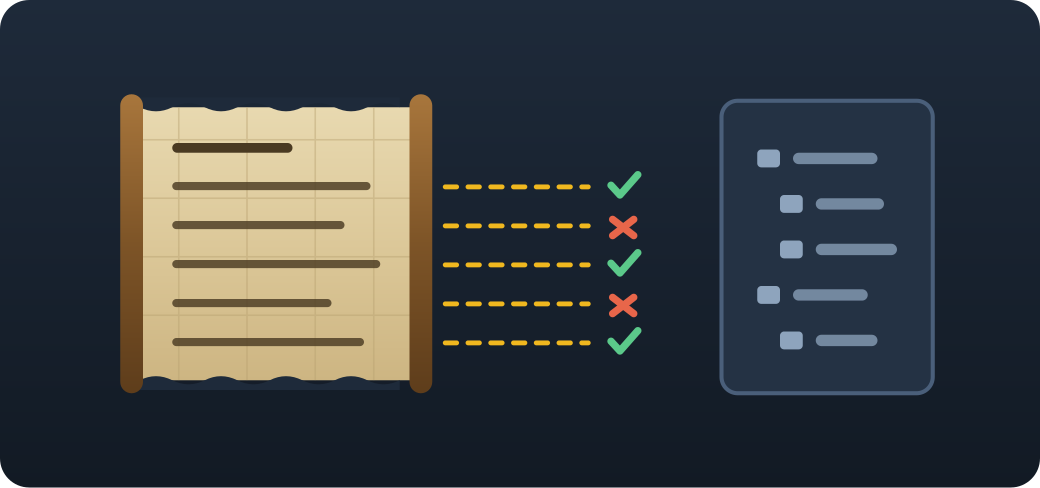


Keep your agent instructions true.
You wrote rules for your AI months ago. Since then a script got renamed, a folder moved, a habit changed — and the AI still trusts every word. The file never complains when it goes stale; it just keeps instructing, confidently, and you live with the results.
Etymd reads those instruction files — and, when you ask, the task you are about to hand an agent — and checks every claim against your actual project.
One command, run in your project's folder (needs Node ≥ 18.17, nothing else): npx etymd audit.
Here it is on a small demo project whose AGENTS.md still tells the AI to run npm run start and
npm run lint and points at a src/legacy/ folder — none of which exist any more:
$ npx etymd audit

  RISK   AGENTS.md tells agents to run `start` — no such script exists
         evidence  AGENTS.md: `npm run start` · package.json scripts (root + workspaces)
         why       An agent following this instruction runs a command that fails — or silently skips the check it was meant to run.
         action    Update the instruction to the current script name (or restore the script).
         effort S · confidence high · instruction-truth · instruction-truth/stale-command:AGENTS.md:start

  ...

  GAP    AGENTS.md references `src/legacy` — it does not exist in the repo
         evidence  AGENTS.md · missing: src/legacy
         why       Agents navigate by these references; a dead path wastes a lookup and erodes trust in the rest of the file.
         action    Fix or remove the reference.
         effort S · confidence medium · instruction-truth · instruction-truth/stale-path:AGENTS.md:src/legacy

  since last audit: 3 still open
Each entry names something that is no longer true, shows the evidence it found, and suggests the smallest fix. And it remembers between runs: a problem you fixed — or looked at and deliberately waved off — never nags you twice.
That's the whole deal. It works with zero configuration and never rewrites your files — the
memory it keeps between runs lives in one small folder of its own (.etymd/). Everything below
the line is reference — read it when you need it.
From Greek étymon — a word's true, original sense (→ etymology) — clipped to etym. + the .md family it guards.
- Truth is a property over time, not a point in time. Instruction files are load-bearing now —
coding agents (Claude Code, Codex, Cursor, Copilot, Gemini, …) read
AGENTS.mdnatively, and a stale claim doesn't error, it silently misleads every session. Linters for these files check a moment; Etymd measures drift against a committed baseline and remembers findings in a ledger, so fixed things stay fixed and a returning problem is named a regression (all four words defined just below). It runs when you invoke it — or when a hook or CI job you wire up does. - Honesty is structural. Every report declares what it could NOT see — CI jobs inherited from unreadable org templates, server-side quality-gate thresholds, heuristics it skipped. No guess is ever dressed as a fact.
- Precision over recall. A false "your file is lying" costs more trust than a missed lie, so the checks filter aggressively — and every class of claim they skip is counted and disclosed, never silently dropped.
| The docs say | It means |
|---|---|
| finding | One verified problem, ranked RISK (an agent acting on this does the wrong thing) → GAP (a dead reference or missing safeguard) → POLISH (worth tidying). Within a tier, cheapest fix first. |
| claim | Anything an instruction file asserts about the project that can be checked: a command it tells agents to run, a path it points at, a rule about tooling. |
| lens | One self-contained checker for one kind of truth (are the commands real? is the state doc current?). An audit is all lenses run together. |
| baseline | A snapshot of the repo's checkable facts that you approved and committed. Drift is measured against this — not against whatever yesterday's cache happened to hold. |
| drift | The distance between the baseline and the repo today: what existed at approval and is now gone, renamed, or moved. |
| ledger | The committed memory of findings — each one's status and history. A finding that was fixed and comes back is a regression, and the report names it as one rather than re-introducing it as new. |
| dismiss vs accept | Two deliberate ways to close a finding. Dismiss = "not a real problem, here's why" — it never resurfaces unless it regresses. Accept = "true, and we're living with it" — kept in the ledger, out of the report. |
| gate | A check that can actually fail a change: a git hook, a CI job. A job marked allow_failure is advisory, not a gate — a check that cannot fail anything is an opinion. |
| disclosure | The report's account of what it could not see or refused to guess about. Every report carries one; a clean result with no disclosures would be the exact dishonesty this tool exists to catch. |
| fleet | Your fleet of repositories — every repo you registered in one manifest, swept by one command. Not a fleet of AI agents. |
| context economy | The words your instruction files load into every single session, measured against a budget. Context is a cost you pay per conversation; leaner files are cheaper and better obeyed. |
- "It missed an obvious stale command." Without
node_modulesinstalled, command claims are skipped — and the skip is disclosed in the report. A command might resolve to an installed binary, and Etymd would rather say "couldn't check" than accuse an honest file. Install dependencies and run again. etymd auditworks withoutetymd init. You only lose drift-over-time measurement — with no committed baseline, there is nothing to measure drift against. Everything else runs.etymd initnever overwrites an existingAGENTS.md. It scaffolds a minimal one only if you have none. The feared overwrite path simply does not exist.- "The shellcheck step announced that it skipped." That is the intended behaviour, not a misconfiguration: where the binary is absent the hook says so and names the install command, because a check that goes quiet when its tool is missing looks installed everywhere and is installed nowhere.
cd your-project
npx etymd audit         # verify every instruction claim against the repo
npx etymd init          # opt in to drift: approve the baseline (+ scaffold AGENTS.md only if you have none)
npx etymd audit --fail-on risk   # the CI gate
npx etymd premise "fix the flaky test in src/legacy/foo.test.ts"   # is this the right task?
audit needs no setup — without init you get the full findings report and lose only drift
measured against a committed baseline. init is that opt-in, not a prerequisite, and it never
overwrites an existing AGENTS.md. On npm since v0.1.0 — npx etymd just works. To wire the
gate into a pipeline, see In CI.
instruction-truth — over AGENTS.md, CLAUDE.md, GEMINI.md, Copilot instructions,
.cursor/rules/*, .clinerules, .claude/skills/*/SKILL.md:
- Command claims — every
pnpm X/npm run Xthe files tell agents to run must exist inpackage.jsonscripts. - Path claims — every repo path the files point at must exist (conservative heuristics; what's
skipped is disclosed). A path the surrounding prose tells the agent to create, and an obvious
naming stand-in like
my-custom-skill, are forward-looking instructions, not stale references. - Package-manager consistency — instructions must not command
yarnin apnpmrepo. - Cross-references — pointer chains (
CLAUDE.md→AGENTS.md→ state docs) must resolve. - Drift vs baseline — documented commands/artifacts/layout that existed at approval and are now gone.
premise (via etymd premise) — the task itself is an instruction. Before an agent acts on
it, every path, script, well-known doc and decision id the task names is checked with the same
rules instruction files get. A path the task is about and that does not exist ranks as risk:
the task would solve the wrong problem precisely. What cannot be read from files — that the named
things are the ones meant, that the mechanism the task assumes actually runs, that the state it
assumes holds — is handed to the agent in a brief, never guessed at. Nothing is remembered between
runs.
gate-integrity — a CI config is a claim too: checks enforced only in CI (failures surface a
slow pipeline after the agent finished — etymd gates generates the local mirror), checks only in
skippable local hooks, latent gaps (coverage collected but nothing gates on it; commitlint
installed but unwired). allow_failure jobs count as advisory, never as gates.
context-economy — the always-loaded footprint in words/tokens (only genuinely
alwaysApply Cursor rules count), flagging files worth extracting into on-demand skills. Context
is the dominant cost of the loop; a lean contract is a correctness feature.
state-freshness — the layer that claims "this describes now" (PROJECT_CONTEXT.md,
DECISIONS.md, ADR dirs), judged by git committer dates only, never mtime. Staleness is
relative — a state doc is stale only when the repo moved past it, so a dormant repo's old
state is current; a tracked file with uncommitted edits is treated fresh-now (the refresh is
already on disk) and disclosed. Decisions records get format checks (Scope: presence, a
Revisit: date that, once past, becomes a finding) — opt in by adding the literal marker
<!-- decisions-format: 1 --> anywhere in the file; forward-only, never retroactive. A file can
require field names of its own by appending them to the marker —
<!-- decisions-format: 1 fields=Owner,Rollback --> — and each is then checked on every entry.
Etymd ships no field vocabulary and reads no meaning into the names; it verifies only that what
the file declared is present, and discloses any name it could not use. Duplicate
or out-of-order D-NNN ids are flagged with a rename action even without the marker — an
append race is a defect in the file's own convention, not a format opinion.
fleet-manifest (via etymd fleet) — one truth guard across every repo you registered:
per-repo audits plus checks on the fleet manifest itself and on the placement wall between
personal and employer repos. See the fleet manifest below.
| Command | What it does |
|---|---|
etymd audit |
Verify every claim; ranked findings (risk → gap → polish) + ledger diff. --lens, --truth, --json, --no-ledger, --fail-on <tier>. |
etymd init |
Onboard: approve the committed baseline; scaffold a minimal AGENTS.md only if missing. Never overwrites. |
etymd doctor |
Alias for audit --truth. |
etymd context |
The economy view: per-file always-loaded footprint + extraction candidates. |
etymd gates |
Install local git-hook gates (pre-commit / commit-msg / pre-push, plus a publish screen where something ships) built from your own check scripts — and from the repo's shell surface, where it has one. |
etymd screen |
Content screen: find text that must never be published. Four scopes — --staged, --message, --tree, --dir. Bring your own patterns; etymd ships none. |
etymd scan |
The deterministic reckoning behind everything. --json. |
etymd brief |
A grounded briefing your in-repo agent completes to author the semantic layer. |
etymd premise |
premise "<task>" — is this the right task? What it names, verified against the repo; a brief for what only the agent can verify. --file (- = stdin), --json, --no-brief, --fail-on <tier>. No ledger. |
etymd approve |
Refresh the committed baseline non-interactively after intentional structural changes. |
etymd ledger |
The findings memory: every tracked finding with status and history. |
etymd dismiss |
dismiss <id> --reason <text> — a dismissed finding never resurfaces without regressing. |
etymd accept |
accept <id> — record a finding as accepted reality; visible in the ledger, out of the report. |
etymd fleet |
Sweep every project in a fleet manifest: read-only per-repo audits + manifest/wall checks. --manifest, --only, --profile, --truth, --persist-ledgers, --json, --fail-on. |
etymd fleet check |
Validate the manifest pair alone (no lenses): dangling mappings, duplicate names, privacy leaks, undeclared trust, machine paths. Non-zero exit on any finding. |
etymd fleet add |
add <dir> — register a project: scans it, asks for what no scan can derive, and refuses to write an entry missing a mandatory field. --name, --kind, --profile, --trust, -y. |
etymd fleet dismiss / accept |
<name> <id> — resolve a project's finding from any cwd; corp findings persist beside the manifest, never in the corp worktree. |
--cwd <dir> targets another directory. Read-only probing of any repo leaves zero trace
(audit --no-ledger writes nothing).
| Path | Lifecycle | Role |
|---|---|---|
.etymd/baseline.json |
committed | the approved reckoning drift is measured against |
.etymd/ledger.json |
committed | the findings memory: statuses, diffs, dismissals |
.etymd/config.json |
committed | optional: audit scope + context budgets |
.etymd/cache/ |
gitignored | transient scan cache |
The committed files are written to be publishable: the baseline records "." as its scan root, never
your absolute machine path. Only the gitignored cache keeps the real one.
Formatter interop: if your Prettier (or similar formatter) checks JSON, add .etymd to
.prettierignore — Etymd writes its own JSON style, and a format gate fighting the ledger is
noise (this repo does exactly that).
Every key is optional; omit the file entirely and the defaults below apply.
Globs are repo-relative: * within a path segment, ** across segments, ? one character. A
pattern with no wildcard is a path prefix, so .claude/skills covers everything beneath it.
Narrowing an audit can hide findings, so Etymd never lets it happen quietly. Honesty is structural: every excluded file is counted and named in the lens disclosures, and a config that fails to parse is reported as a disclosure rather than silently falling back to defaults.
The gate is one command:
npx etymd audit --no-ledger --fail-on riskExit-code contract: without --fail-on, audit reports and exits 0 no matter what it found.
With --fail-on <tier> (risk | gap | polish) it exits non-zero when any finding at or
above that tier exists — so --fail-on risk blocks on risks only, --fail-on polish blocks on
everything. --no-ledger keeps the CI run read-only: the throwaway checkout is never written.
The ledger and baseline are not CI by-products — they are committed, reviewable state,
updated locally and read in CI. A dismissal (with its reason), an accepted finding, a baseline
refresh after an intentional restructure: each lands in .etymd/ and shows up in the pull
request diff like any other change. Keep .etymd out of your formatter's reach (see
the files Etymd keeps).
A check that runs only in CI is itself a finding: the failure surfaces after the agent finished.
etymd gates installs the local pre-commit / pre-push mirror built from your own check scripts —
and from the repo's shell scripts, which usually have no check of their own — while the
gate-integrity lens flags whatever still runs in CI alone.
Generated hooks are overwritten on every etymd gates run, so nothing hand-written belongs in
them. Each one calls a companion instead — .githooks/pre-commit.local, commit-msg.local,
pre-push.local — that etymd never reads, writes, or regenerates. Make it executable and it
runs; a non-zero exit stops the commit or push exactly as the generated checks do.
Commit the companion, and check your
.gitignorefirst. A*.localrule — common for env files, and shipped by some framework templates — silently swallows these too. The guard then works on the machine that wrote it and is absent for everyone who clones, which looks identical to having no guard at all. Add!.githooks/*.localif that rule exists.
cat > .githooks/pre-commit.local <<'EOF'
#!/usr/bin/env sh
# Whatever this project needs — etymd will not touch this file.
./scripts/check-changelog.sh || exit 1
EOF
chmod +x .githooks/pre-commit.localTwo files, two owners. The generated half stays byte-identical to what the pack produces, which is what lets drift detection say something precise: a difference there means the managed part was edited or went stale, never that you added a check of your own. Delete the companion and its checks stop running — that is what deleting a file means, and etymd does not police a file it does not own.
Package scripts are not the only executable surface a repo has, and in some repos they are not
the main one — a tools or infra repo can be entirely bootstrap/*.sh plus .githooks/* with no
package.json at all. Those repos were told "no correctness commands detected", which reads as
"nothing to check" when it means "nothing was looked at". Where a repo has tracked shell scripts,
the generated pre-push now carries a shellcheck step. Three properties are deliberate:
- Scripts are re-discovered by shebang at push time, never baked into the hook as a list. A generated list is correct the day it is written and silently wrong the first time someone adds a script.
- A missing
shellcheckbinary is a loud skip that names the install command, never a quiet pass. A check that goes silent when its tool is absent looks installed on every machine and is installed on one. - Only
warningseverity and above blocks; style and info print as advice afterwards. A gate with a high false-positive rate does not make a repo careful — it teaches everyone the bypass flag, and that flag is shared with the checks that must never be bypassed.
A separate question from "are the instructions true?": does this repo carry text that must never be published? Absolute home paths, an employer's name, an internal hostname, an account identifier — permanent the moment they are committed, because publishing exposes all history, not the current tree.
Etymd ships the mechanism and no patterns, ever. The strings worth screening for are
themselves the sensitive material, so a built-in list would be useless to everyone else and a
leak for whoever wrote it. You supply a pattern file (one regex or literal per line, # for
comments) at ~/.config/etymd/screen-patterns or via --patterns. Without one the command is
inert and says so — it never reports "clean" for a check it did not run.
etymd gates wires it into four doors, because a leak walks through whichever is unguarded:
| door | scope | what only it can catch |
|---|---|---|
pre-commit |
staged file bytes | the ordinary case, at the cheapest moment to fix |
commit-msg |
the message itself | the staged scan reads file bytes and never sees the message |
pre-push |
every tracked file | anything committed with --no-verify, or merged in from else |
prepublishOnly |
the packed artifact | a gitignored file that still ships — see below |
That last door exists because the first three share a blind spot: they all answer "what is in
the repository?". npm and vsce do not honour .gitignore, so a local cache file can be
packaged into a published release while every git-scoped check passes forever.
Every generated hook resolves the screener at run time and no-ops when it is absent, so the
same hook file is safe to commit to a public repo: it carries no patterns and imposes no policy
on anyone who clones it. A deliberate exception on a line you can edit is marked inline with
allow-published-string, visible in the diff.
Some exemptions cannot live on the line itself: a scanner's own source contains the strings it
screens for, its tests contain fixtures that must match, and a bundler strips comments so an
inline marker would not survive into the artifact. Those live in .etymd-screen-allow at the
repo root — one labeled line per field, so the pattern is never delimited:
pattern ^AcmeCorp|BetaCorp$
reason fixture proving the detector fires on either name
date 2026-08-15
author someone
A pattern may contain any character, including the | shown above, without escaping: a
free-form field delimited in-band is an ambiguity in the format itself, and no amount of
parser-side guarding fixes that class — labels move the boundary to the line break, which the
field cannot contain. An entry naming the repo itself needs no provenance — a bare ^widget$
line is a complete record, the exemption being exactly as wide as the name. Anything else
missing a field is reported and does not apply: an exemption is a hole in the gate, and a hole
nobody signed cannot be audited later. The file is read from the repo being screened, never a
shared location, and it screens itself out (it necessarily contains every string it exempts).
Off unless you turn it on:
{ "gates": { "commitFormat": true } }in .etymd/config.json. Then the commit-msg hook also checks the subject against
Conventional Commits — <type>[(scope)][!]: <summary>,
with feat fix docs style refactor perf test build ci chore revert as the types. It is a format
check and not a taste check: it asks whether a machine can classify the line, and stops there.
An over-long subject is reported as advice and never blocks, and the subjects git writes for you
— merge, revert, fixup, squash, amend — are exempt, since gating those would ask you to rewrite
text you did not write.
It is the one generated check that needs nothing installed, and therefore the one that would run for everyone who clones your repo. That is exactly why it is off by default. Every other check the pack writes is either derived from what your repo already does or inert without a checker you installed yourself; a commit convention is neither — it is an opinion, and this tool does not hold opinions on your behalf.
Turn it on where the convention is already yours. A convention nobody gates does not get abandoned in a decision you could point at: it erodes one hurried commit at a time, and by the time the log reads as a mixture, every commit in it is already published.
Modeled on this repo's own workflow (Etymd guards its own instructions with Etymd — its CI runs the same gate against its own freshly built CLI):
steps:
- uses: actions/checkout@v4
- uses: actions/setup-node@v4
with:
node-version: 20
cache: npm
- run: npm ci
- run: npx etymd audit --no-ledger --fail-on risketymd fleet extends the one objective across every repository you work in — your fleet of
repositories, not a fleet of agents. The manifest, registry.json, is itself an
agent-context file: claims about your fleet (what exists, where, under which profile — the
side of the wall an entry belongs to, personal or corp; the wall is the placement
boundary between personal and employer content that the sweep polices). It rots like any
AGENTS.md does, and etymd fleet keeps it true. Decision record:
docs/decisions/004-fleet-truth-guard.md. Both the
registry schema and the fleet --json schema are experimental through 0.2.x.
Two files beside each other — the split is the privacy model:
registry.json (tracked; safe to publish by construction):
{
"registryVersion": 1,
"root": "~/projects", // ~ expands on the consumer side — never a machine home
"orientation": { "root": "notes" }, // optional: the entry every other entry is guided by
"projects": [
{
"name": "web-app",
"kind": "repo",
"profile": "personal",
"path": "web-app",
"trust": "private",
},
{
"name": "notes",
"kind": "docs",
"profile": "personal",
"path": "notes",
"trust": "private", // mandatory on every non-corp entry — see below
"staleAfterDays": 45, // per-entry freshness window
"contract": { "state": "STATUS.md" }, // native conventions register, never migrate
},
{
"name": "my-fork",
"kind": "tool",
"profile": "personal",
"path": "my-fork",
"upstream": "origin", // freshness measured on fork-authored commits only
"trust": "public-repo", // hygiene needles apply (see below)
},
// Corp entries: opaque alias, private, NO path — real dirs live only in the local file.
{ "name": "c-one", "kind": "repo", "profile": "corp", "private": true, "staleAfterDays": 45 },
],
}registry.local.json (gitignored; this machine's facts — each one an identifier you don't ship):
{
"machineProfile": "corp", // which profile this machine resolves; "personal" resolves corp entries disclosed-absent
"root": "~/projects", // optional per-machine root override
"dirs": { "c-one": "~/projects/real-corp-dir" },
"labels": { "c-one": "real-corp-dir" },
"corpHosts": ["git.example-corp.com"],
}Two fields the scan can never derive, so the manifest must declare them:
trust— mandatory on every non-corp entry (public-repo|public-bound|private). It is a safety predicate, not a label: it decides whether content screening applies, so an absent value is reported (fleet checkflags it), never read as a silentprivate.public-boundmeans private today, plausibly public later — screened exactly as hard as public, because publishing exposes all history: the scrub has to precede the first commit, not the visibility flip. A value outside the vocabulary is flagged rather than coerced, so a typo can never quietly disable screening. Corp entries omit it —profile: "corp"already implies the answer.orientation.root— optional, declared once. Names the one entry every other entry is guided by. Declared at the manifest level rather than repeated per entry, because a per-entry link carries no information and can be forgotten: hoisting it makes an unoriented project unrepresentable instead of merely detectable. Fleets without an orientation root omit the block — etymd never assumes one.
etymd fleet add <dir> is the gate that keeps both true: it scans the project, prompts for what
no scan can derive, and refuses to write an incomplete entry. Non-interactive runs (--yes,
CI) must pass every mandatory value as a flag — there is deliberately no default.
How the sweep behaves:
- Read-only by default, everywhere. The sweep never creates
.etymdanywhere.--persist-ledgerspersists only into personal repos that already opted in, and a corp worktree is never written — regardless of flags, even if a stray.etymdexists inside it (pinned by test). Corp findings stay dismissible: their ledger lives at<manifest-dir>/corp/<name>/.etymd/, beside the manifest. - Deltas. Each sweep compares against
last.fleet.jsonstored beside the manifest and rendersΔ +new −resolvedper project. Add*.fleet.jsonto the manifest repo's.gitignore— sweep output is local-only and never tracked. - Recurring classes. A finding class open in two or more projects renders as its own section of class-fix candidates (worst tier first) — the sweep asking "repo bug or fleet bug?", a fleet-level lesson no per-repo audit can see. The sweep only groups; the class vocabulary is minted by the engine's lenses.
- Declared absence is honored. An entry whose contract declares
"placement": "none"states that instruction files are legitimately absent in that project — the sweep drops its missing-contract finding instead of re-reporting a decision every run. Absence disclosed on purpose is a state, not a gap. - Wall checks. Corp contract files found inside a corp worktree, unregistered checkouts
under the fleet root whose remotes match
corpHosts, tracked/Users/paths in the manifest repo, private needles — the identifiers the local file holds (labels, dir names, hosts) — insidetrust: "public-repo"entries, and corp-host commit emails on personal entries — each a risk finding; each check that cannot run is disclosed. - No global pointer.
--manifestis required unless the cwd holdsregistry.json— there is deliberately no env var and no home-directory pointer.
Formatter interop for the .etymd state the sweep resolves: same rule as everywhere — see
the files Etymd keeps.
import { runAudit } from "etymd"
const audit = await runAudit(process.cwd(), { persistLedger: false })
console.log(audit.findings) // one schema: claim · evidence · why · action · effort · confidenceEtymd is developed against a corpus of real sibling repos rather than fixtures alone —
sources.json lists them by shape. Every heuristic here exists because a real
repo proved the previous one wrong, and each skip class in the truth lens is a false positive that
a corpus run caught.
Some corpus entries are private and are named by shape (nx-monorepo, spa-bff, cra-legacy)
rather than by directory. To run those smokes locally, add an untracked sources.local.json
mapping each name to its sibling directory:
{ "dirs": { "nx-monorepo": "my-monorepo-checkout" } }Each value is resolved as a sibling of the Etymd checkout.
Without it — on a fresh clone or in CI — those suites skip cleanly and the rest still run.
docs/decisions/ — 001 founding · 002 foundation re-lock · 003 the truth-guard
pivot (the current identity; includes the state-of-the-field investigation it rests on) ·
004 fleet mode (the truth guard across your repositories) · 005 declared rules (design only) ·
006 local gate provenance (what the tool may read, and what it may rewrite).
ROADMAP.md — what's now / next / later, and the accepted heuristic
trade-offs.
MIT
{
  "instructions": {
    // Audit these too — files detection would not find on its own.
    "include": ["docs/handbook/**/*.md"],
    // Leave these out. The classic case: a fork that inherits upstream's skills
    // and will never fix them, but must keep its OWN instruction layer honest.
    "exclude": [".claude/skills/**"],
  },
  "context": {
    "perFileWords": 4000, // extraction candidate above this
    "totalWords": 8000, // always-loaded footprint budget
  },
  "gates": {
    // What `etymd gates` generates. Written for you on first run from what the scan
    // finds — edit it here rather than editing the generated hook, so the next run
    // agrees with you instead of arguing.
    "commands": ["typecheck", "lint"], // pre-push steps, in order
    "failOn": "risk", // audit tier that fails the push: risk | gap | polish
    "publishGate": true, // screen the published artifact
    "commitFormat": true, // check the commit subject — Conventional Commits, off unless set
    "allowWriting": [], // commands allowed into a gate despite writing
    // Why a value here is what it is. Each key mirrors the field it explains, so the
    // note says what it refers to instead of sitting near it and hoping. Etymd keeps
    // these, and DROPS one whose field it changes — a reason attached to a value it no
    // longer explains is worse than no reason at all.
    "_why": { "failOn": "no build and no tests here; only docs drift can fire" },
  },
}