
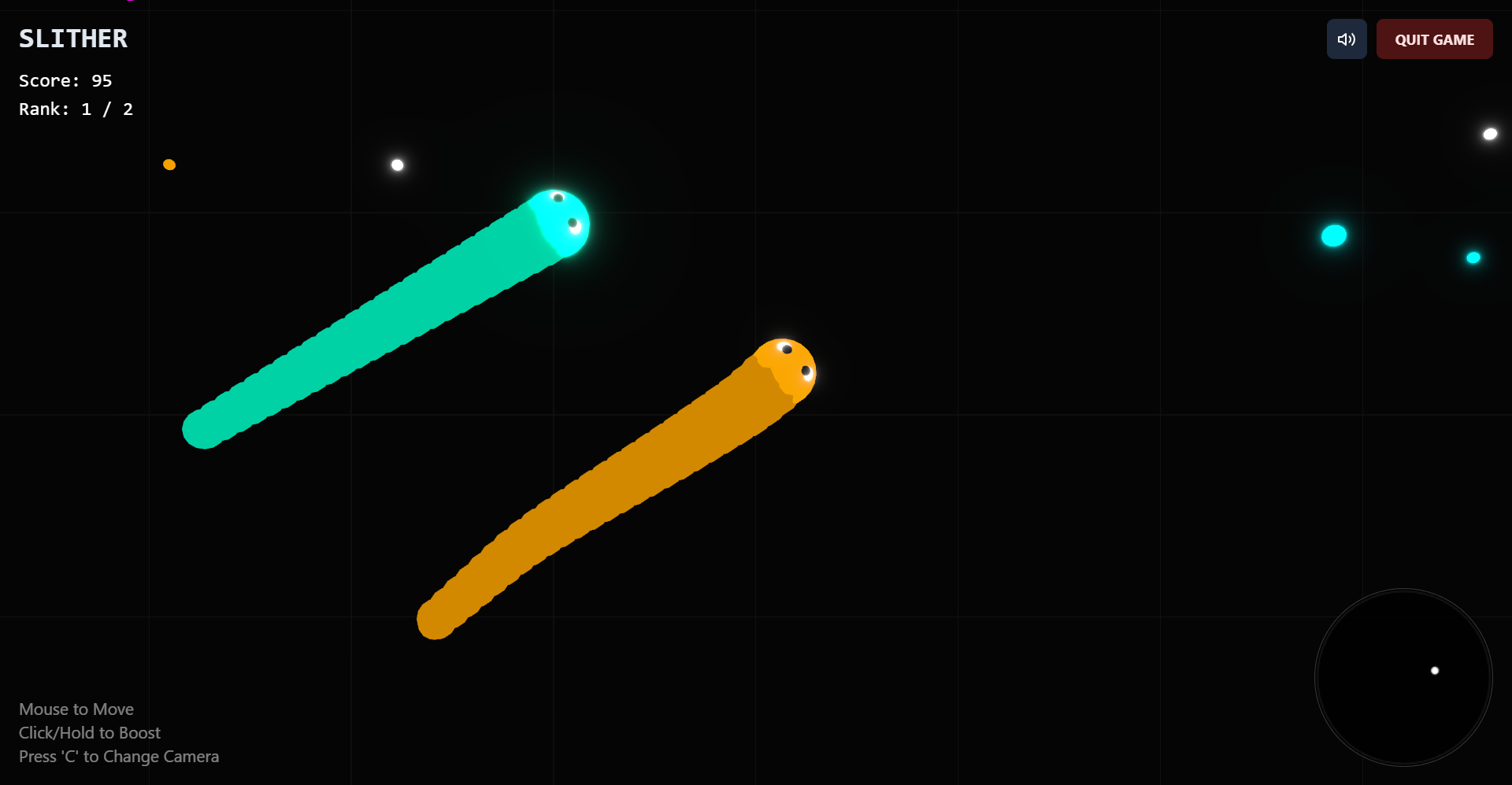
A high-performance, real-time multiplayer snake game demonstrating advanced networking techniques and 3D graphics optimization.
Live Demo • Technical Achievements • Architecture • Getting Started
Performance Note: The live demo backend runs on a free-tier server with extremely limited resources:
| Resource | Allocation |
|---|---|
| CPU | 0.1 vCPU (Shared) |
| RAM | 512 MB |
| Disk | 2 GB |
Due to these constraints, you may experience:
- Higher latency (100-300ms+ depending on your region)
- Occasional frame drops during peak usage
For optimal experience, run the project locally using Docker (see Getting Started). The codebase is fully optimized for production-grade hardware.
This project showcases production-ready solutions to common challenges in real-time multiplayer game development:
Problem: Broadcasting full game state (5000+ food entities × 30 ticks/sec) would consume ~9 MB/s per client.
Solution: Implemented delta compression - only transmitting state changes:
// Server only sends:
{
  "snakes": { ... },           // Always sent (positions change every tick)
  "food": [ /* NEW food */ ],  // Only newly spawned food
  "eatenFood": [ 0.123, ... ]  // IDs of consumed food for client-side removal
}Result: >95% bandwidth reduction while maintaining full state consistency.
Problem: Network latency causes visible "teleporting" when rendering server-authoritative positions directly.
Solution: Implemented client-side extrapolation that predicts entity positions based on velocity:
// Predict where entity WILL be, not where it WAS
const predictedX = serverPos.x + Math.cos(angle) * speed * predictionTime;
const predictedY = serverPos.y + Math.sin(angle) * speed * predictionTime;

// Smoothly converge to prediction
position.lerp(predicted, smoothingFactor * delta);Result: Butter-smooth 60 FPS gameplay even with 200ms+ latency.
Problem: Naive O(n²) collision checks between thousands of entities causes server CPU spikes.
Solution: Implemented spatial partitioning using a hash grid:
// Only check collisions within nearby cells
nearbyEntities := grid.Query(entity.X, entity.Y, radius)
for _, other := range nearbyEntities {
    checkCollision(entity, other)
}Result: Collision detection scales to 10,000+ entities on minimal hardware.
Problem: High-DPI mobile devices (3x-4x pixel ratio) struggle with 3D rendering.
Solution: Multi-pronged optimization strategy:
- DPR Capping: Maximum 1.5x pixel ratio (vs native 3x-4x)
- Geometry LOD: Reduced sphere segments (8×8 body, 12×12 head)
- Instanced Rendering: Single draw call for 5000+ food particles
Result: Stable 60 FPS on mid-range mobile devices.
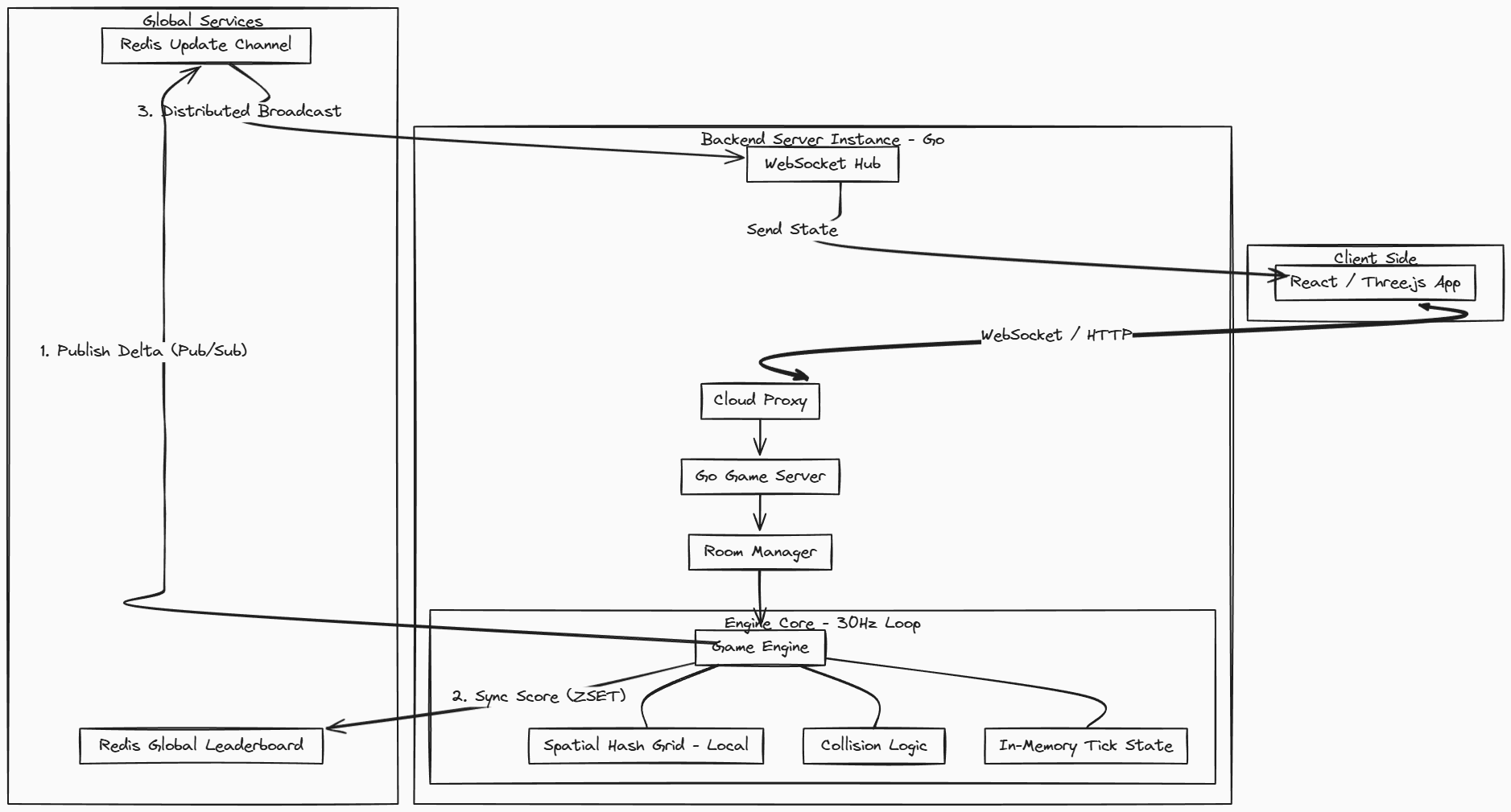
| Decision | Rationale |
|---|---|
| Authoritative Server | Prevents cheating; server is single source of truth |
| WebSocket over HTTP | Enables bi-directional, low-overhead real-time communication |
| Go for Backend | Excellent concurrency model (goroutines), minimal memory footprint |
| React Three Fiber | Declarative 3D with React's component model, easy state management |
| Delta Sync | Critical for bandwidth-constrained mobile/free-tier environments |
| Layer | Technology | Purpose |
|---|---|---|
| Backend | Go 1.24, Gorilla WebSocket | Authoritative game server, real-time communication |
| Frontend | React 19, TypeScript, Vite | UI framework, type safety, fast HMR |
| Graphics | Three.js, React Three Fiber, Postprocessing | 3D rendering, bloom effects |
| Styling | TailwindCSS | Utility-first responsive design |
| Deployment | Docker (Multi-stage Alpine), Vercel, Koyeb (free plan) | Containerization, CDN, backend hosting |
- Docker Desktop (recommended)
- Node.js 18+ (for frontend development)
- Go 1.24+ (optional, for backend development without Docker)
# Clone the repository
git clone https://github.com/kyyril/slither.git
cd slither

# Start backend with Docker
docker compose up -d --build

# Install frontend dependencies and run
npm install
npm run dev
Open http://localhost:5173 to play!
| Variable | Description | Default |
|---|---|---|
PORT |
Server listening port | 8080 |
VITE_SERVER_URL |
WebSocket server URL (frontend) | localhost:8080 |
ALLOWED_ORIGINS |
CORS allowed origins | * |
slither/
├── server/                    # Go Backend
│   ├── engine/
│   │   ├── game_engine.go     # Core game loop, physics, delta tracking
│   │   └── spatial_hash.go    # O(1) spatial queries
│   ├── network/
│   │   └── websocket.go       # WebSocket hub, client management
│   ├── manager/
│   │   └── room_manager.go    # Multi-room support
│   ├── models/
│   │   └── game_types.go      # Shared data structures
│   └── main.go                # Entry point, HTTP routes
│
├── src/                       # React Frontend
│   ├── components/
│   │   ├── GameScene.tsx      # Three.js scene, camera, input handling
│   │   ├── Snake.tsx          # Instanced mesh rendering, interpolation
│   │   ├── FoodField.tsx      # 5000+ particle instancing
│   │   └── UI.tsx             # HUD, mobile orientation lock
│   ├── game/
│   │   └── GameEngine.ts      # Singleton state manager, WebSocket client
│   └── App.tsx                # Root component, connection state machine
│
├── Dockerfile                 # Multi-stage production build
├── docker-compose.yml         # Local development orchestration
└── README.md
| Metric | Value |
|---|---|
| Server Tick Rate | 30 Hz |
| Target Client FPS | 60 FPS |
| Avg Packet Size (Delta) | < 5 KB |
| Max Concurrent Snakes Tested | 50+ |
| Food Entity Count | 5,000 |
| Collision Checks/Tick | O(n) with spatial hash |
- Slither.io - Inspiration for gameplay mechanics
- Gorilla WebSocket - Production-grade WebSocket for Go
- React Three Fiber - Declarative Three.js in React
- Postprocessing - Bloom effects
MIT License - feel free to use this project for learning or as a portfolio piece.
Built by kyyril