
Mateu is a model-driven UI system for building business applications: you declare what a screen contains — in code (Java, C# or Python) or in YAML — and Mateu derives the UI, across web and native, served by a backend or shipped as a static bundle. Java is the reference implementation; .NET and Python speak the same wire, and the same model can be authored as pure data.
It spans the spectrum from code-first (pro developers) to low-code/no-code (YAML + the visual editor). Backend-driven and low-code are modes it supports, not what it is.
An LLM will write you a React admin panel in a minute. So "less code" is no longer the point.
The point is what happens on day 200.
Generated code derives from your model and then diverges from it: the moment someone edits it, it is theirs to maintain, and it drifts. Mateu does not generate the UI — it derives it, so it cannot drift. Change the model and the screen is already correct.
That is one distinction, and it is the whole framework:
Source of truth vs artifact. You maintain the declaration. Everything downstream — the UI, the API contract it implies, a static bundle — is derived, and nobody edits it.
| A domain model? | Declare @UI classes — inside-out |
| A design or a mockup? | Draw it in the visual editor — outside-in |
| An existing REST API? | Point the screens at it |
| Prefer data over code? | Declare it in YAML — type: UI mounts, routes.yaml, layout definitions |
They all land on the same declaration. Code-first tools cannot start from a design; design-first low-code tools cannot start from your domain model.
Each service ships its own screens inside its own jar — the UI module needs one dependency and no framework coupling — and they aggregate into one shell, or embed into an IDE, a mobile app or another product's page. Eight teams can own, version and deploy their slice of the same back office independently.
That is micro-frontends without the micro-frontend tax: what federates is a declaration, not a JS bundle, so there is one framework version, no runtime composition and no CSS collisions.
With Mateu, this:
enum ProductStatus {
    Available, OutOfStock
}

record Product(
    @NotEmpty String id,
    @NotEmpty String name,
    @NotNull ProductStatus status
) implements Identifiable {}

@UI("/products")
public class Products extends AutoCrudOrchestrator<Product> {
}
becomes:
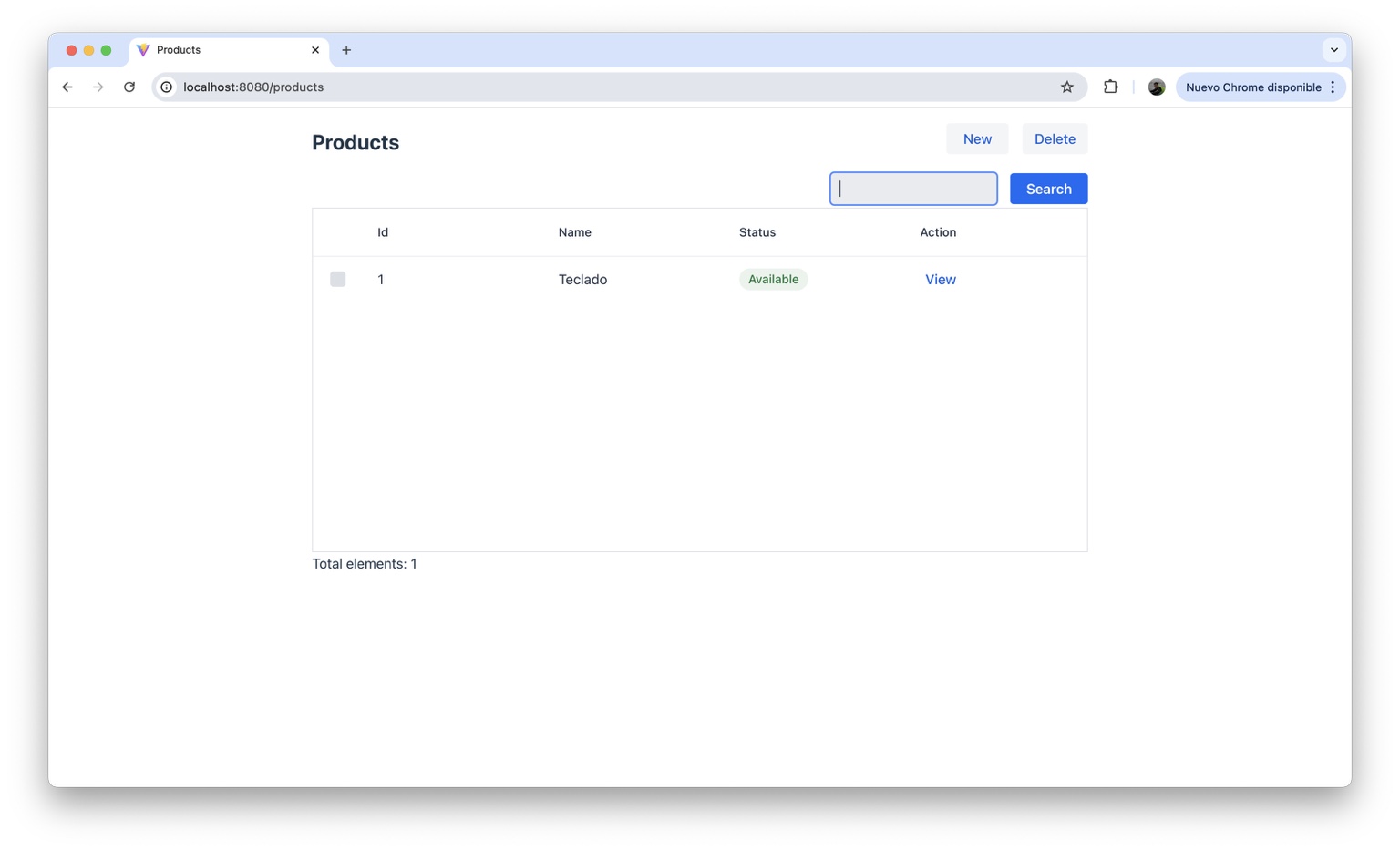
👉 See full example: https://mateu.io/java-user-manual/use-cases/admin-panel/
- forms and inputs from fields
- validation from annotations
- menus from your object model
- full CRUD with minimal code
- responsive UI out of the box
- the same screens on the web, on mobile (React Native) and inside an IDE — no renderer work
- an optional static bundle: the same app served from a CDN with no backend running
Mateu is a great fit for:
- admin panels
- internal tools
- enterprise backoffices
- CRUD-heavy applications
Mateu is not designed for:
- marketing websites
- highly custom visual experiences
- frontend-heavy products
When one screen out of forty does need to be special, you drop to a custom component for that one and keep routing, state, validation, i18n and the rest of the app.
Have questions, ideas or feedback?
👉 Join our Discord: https://discord.gg/YFb9utDMYK
- Docs: https://mateu.io
- Java manual: https://mateu.io/java-user-manual/
Mateu derives real business UIs from a declaration you keep — so they cannot drift away from it.