feat(web): install devices by mDNS name, warn to reserve raw IPs - #714
feat(web): install devices by mDNS name, warn to reserve raw IPs#714HuggeK wants to merge 8 commits into
Conversation


The setup wizard showed a discovered device's mDNS hostname in the scan
table but always bound the raw IP into the driver config. Prefer the
self-broadcast .local name when the device advertises one, so the
connection survives DHCP lease changes; other reverse-DNS names stay
display-only since resolving them depends on the router.

When the configured host is an IP literal, a live hint under the host
field now tells the operator to reserve that IP for the device in the
router's DHCP settings. The Settings device help texts carry the same
advice.

Co-authored-by: HuggeK <48095810+HuggeK@users.noreply.github.com>


 frahlg
left a comment
frahlg
left a comment
frahlg
left a comment
There was a problem hiding this comment.
Read the whole diff. The reasoning is right and the implementation is careful — restricting the preference to .local via isMDNSName() and leaving every other reverse-DNS name display-only is exactly the correct line, since anything else depends on the router's DNS. The live hint on input is a nice touch, and routing saveDriver through one host variable keeps Modbus, MQTT and HTTP consistent.
One concern before this becomes the default, and I could not settle it from here.
Can the official container resolve a .local name at all?
- The runtime image is
alpine:3.22withca-certificatesandtzdata(Dockerfile:39,43). No mDNS resolver, and musl has no NSS plugin mechanism, so the usualnss-mdnsfix is not available the way it is on glibc. - Go's resolver does unicast DNS against the nameservers in
resolv.conf. mDNS is multicast to 224.0.0.251:5353. The repo's own mDNS code (go/internal/scanner/mdns.go) is a hand-rolled multicast query used for discovery; it does not feed the resolver thatmodbus.Dialand the HTTP client use. network_mode: hostmeans the container can reach a host-local stub resolver, so this may work where the host runssystemd-resolvedwith MulticastDNS enabled — and fail where it runsdhcpcd+avahi, which is the common Raspberry Pi OS setup.
So the outcome likely depends on the host, and the PR removes the one sentence that warned about it: "mDNS names work when your OS resolver supports them; otherwise use the LAN IP". config.example.yaml:94 still carries the same caveat — allowed_hosts: ["zap.local"] # use the LAN IP if mDNS is unavailable.
The failure mode is bad: the wizard silently writes inverter.local, the driver never connects, and the operator has no way to tell that name resolution is the reason.
What would settle it: install a discovered device by its .local name on the official image on a Pi and confirm the driver comes online. If it works, this is ready. If it depends on the host resolver, the safer shape is to probe the name before saving and fall back to the IP when it does not resolve — the wizard already knows both.
Not blocking on my side; @erikarenhill owns web/ and this is his call.

|
Branch updated with master (clean merge, no conflicts) — it was ~142 commits behind. On the open review question
No, it could not — the concern was correct. But the reason is not musl, and that matters, because it means no container change fixes it. Go routes case hostname != "" && stringslite.HasPrefix(src.source, "mdns"):
if stringsHasSuffixFold(hostname, ".local") {
return hostLookupCgo, dnsConf
}
So The host-resolver guess doesn't rescue it either. Our Pi image runs NetworkManager ( What unblocks this#728 resolves Two details that matter for this PR specifically:
Suggested merge order#728 first, then this. Merged alone, this PR would write I deliberately left How to confirm the diagnosis on a real PiPrints Contrast on the same host: (An earlier revision of this comment suggested Wider write-up of the audit this came out of: #730. |


# Conflicts:
#	web/setup.test.mjs
Resolving the merge conflict rewrote the file through a text-mode write on Windows, which turned all 176 line endings into CRLF and made a 23-line addition read as a whole-file rewrite. The repo has no .gitattributes and core.autocrlf is false, so the bytes are stored as written.

Co-authored-by: HuggeK <48095810+HuggeK@users.noreply.github.com>
|
Merging this together with #728 does not yet work end to end — one flag is missing between them. This PR makes the wizard write So with both merged, every device the wizard installs by name would be denied before resolution is attempted — the exact failure this PR exists to prevent, arriving from the other direction. Two ways to close it, and they are not equivalent:
I have not implemented either — the second touches a security control on an open review, and that is the reviewer's call rather than mine. Flagging it here so the two PRs are not merged in sequence on the assumption that they compose. |

allow_unverified_local refused the dial outright. That broke two things
that matter more than the risk it was guarding.

srcfl#714 makes the setup wizard write `host: zap.local`, and nothing in web/
sets this flag — so every device installed by the wizard would have been
refused on its first poll, usually the site meter, which stops dispatch.
And a pilot Home Assistant install resolves .local today through
Supervisor's DNS service, on stock v1.10.0-beta.1, with none of this
code: refusing would take a working site and break it.

The risk it guarded is also not one-sided. A raw IP is no more an
identity on a LAN than a name — it can be claimed by ARP, and DHCP can
hand it to another device with nobody attacking anything. Only the name
was gated, and the fallback the gate pushed operators towards is the
option with the extra failure mode.

So the flag now gates what its own doc comment always said: whether FTW
may use *its own* mDNS answer. Without it the name goes to the system
resolver, exactly as before this package existed. With it, avahi and the
LAN are queried too. Both causes are wrapped so errors.Is finds either.

guardMDNSProxy goes with it. Where a proxy is configured FTW never
resolves the destination — the proxy does — so there was nothing for it
to gate, and its tests asserted a contract that no longer holds.

The check that would actually help is on identity after connect: record
make+serial or MAC on first success, fault when it changes. FTW already
collects all three (state.ResolveDeviceID) and never compares them.
Filed separately rather than smuggled in here.

Co-authored-by: HuggeK <48095810+HuggeK@users.noreply.github.com>
Run against a real device, with #728 underneathThe blocker I flagged above is fixed — in #728, not here. Verified on a real Sourceful Zap on the LAN, through
Both work, by different routes, which is the point of the change. Worth noting The multicast path also proved its own need for a fallback: the first attempt The visible changeRendered both versions, same build, same step, master
this PR
The field label moves from What these shots do not showThe addressing hint ( |
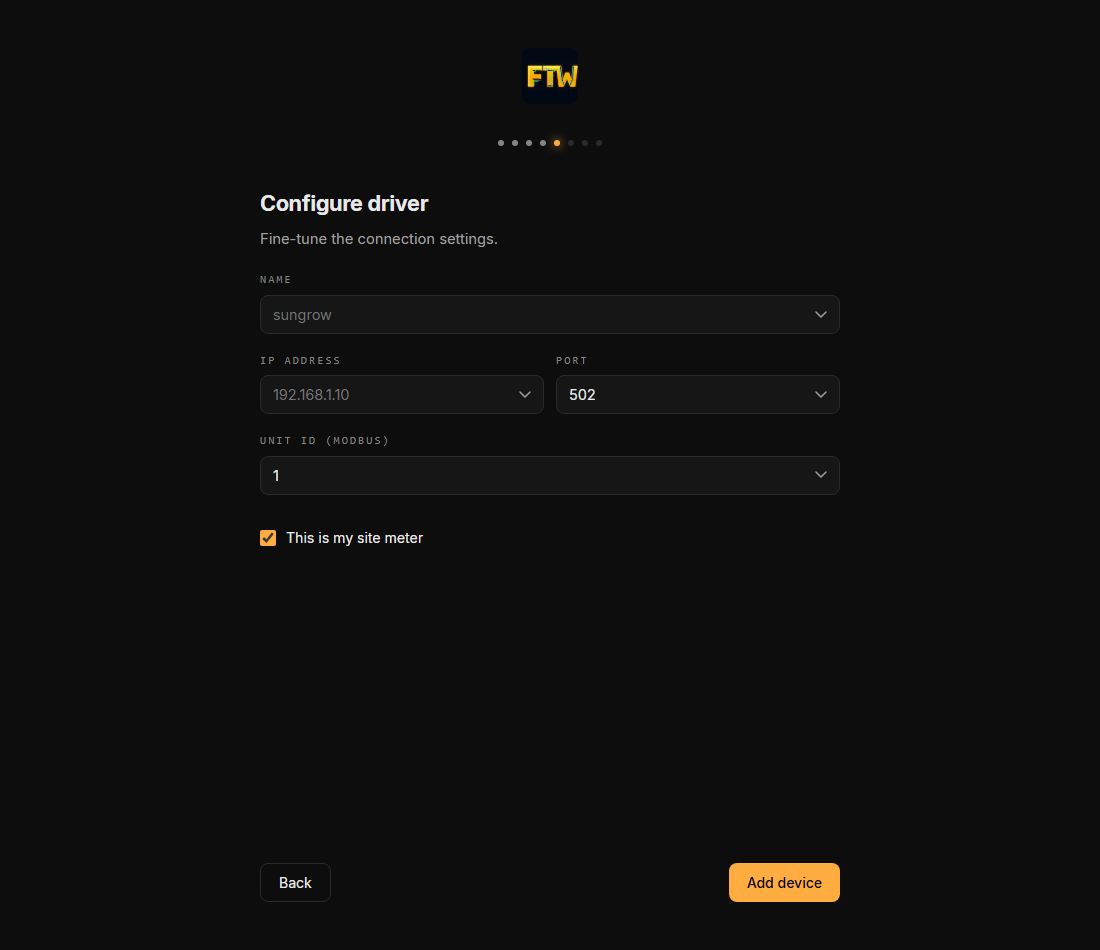
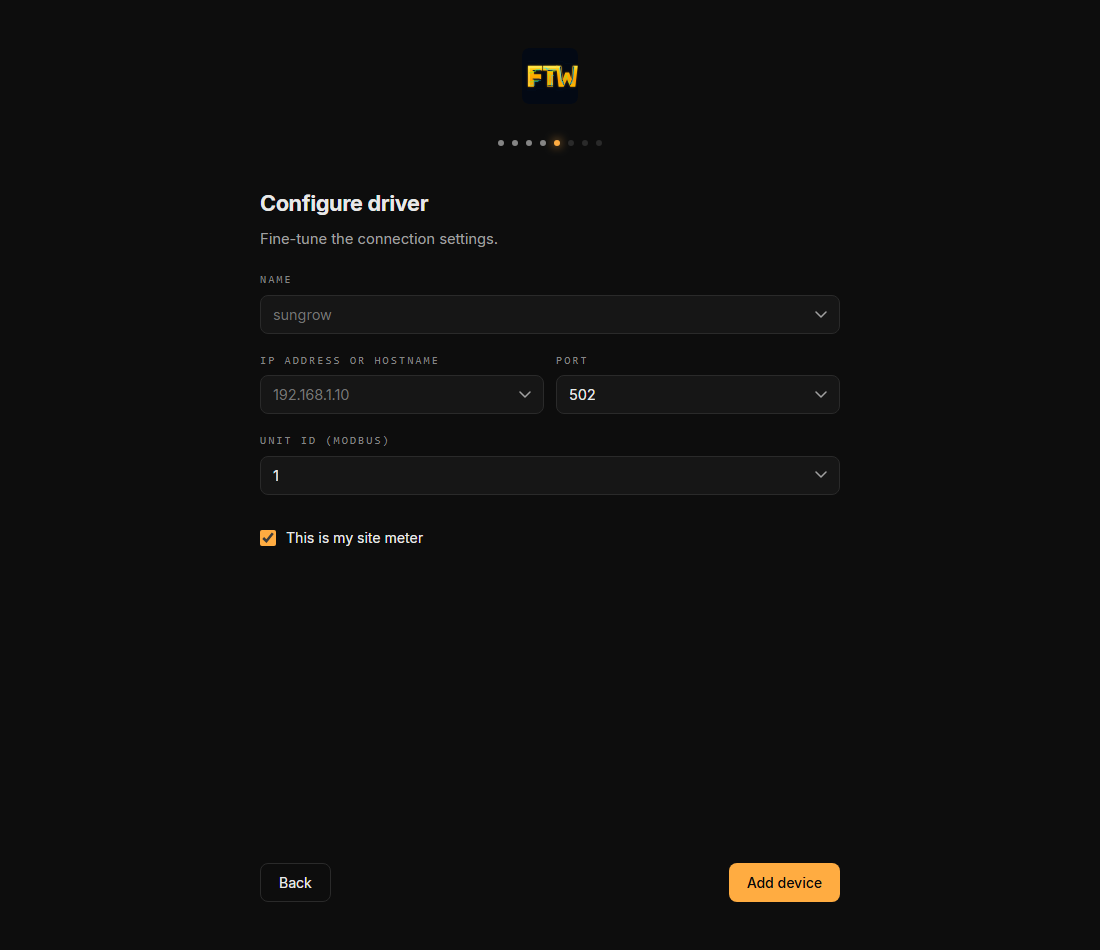
Verified on a real device: the wizard was not choosing the mDNS nameAsked to confirm this PR does what it says, I checked against a live Sourceful
Measured against
Note rows 2 and 3 together: the device answers to a The fixIn #728, since it needs the forward resolver: 4d746ddd Both queries now run concurrently and a After the fix, same address, same code path: Why the round-trip check is there rather than trusting the labelWithout it the router's naming would decide what FTW dials: take whatever It also costs nothing when the device does publish a reverse mDNS record — that Scan latencyUnchanged in the common case and bounded in the worst. The two reverse queries Tests are in |
Co-authored-by: HuggeK <48095810+HuggeK@users.noreply.github.com>
3 participants


Important
This is one half of the feature. It cannot ship alone, and neither can the other half.
"Install a device by name so the connection survives a DHCP move" needs two
things merged:
.local— feat(net): resolve device .local names, asking avahi first #728. This used to be a choicebetween two routes; it no longer is. build: run one base across the whole stack (debian:trixie-slim) #731 merged, putting the whole stack on
one
debian:trixie-slim-derived base, and the Alpine alternative build: one alpine base for core and updater, with .local resolved in Go #746 isclosed. feat(net): resolve device .local names, asking avahi first #728 asks the host
avahi-daemonover its Unix socket and fallsback to its own multicast query where no such socket exists — the Home
Assistant app being the case that only ever has the fallback.
.localname.Neither half delivers the feature on its own. This PR is web-only
(
web/setup.html,web/setup.js,web/settings/tabs/devices.js), so until itlands the resolver is in place but the UI keeps writing raw IPs and a normal
install sees no change.
The order is not symmetric, which is why this one is the blocked one:
flow, and it already repairs hand-written
.localconfigs — including thezap.localandsid-os.localexamples documented inconfig.example.yaml,which cannot resolve on
mastertoday.that matters. Measured since: under Home Assistant a
.localname alreadyresolves without feat(net): resolve device .local names, asking avahi first #728, because Supervisor points every app at its own DNS
service and that service answers mDNS names — verified on a pilot install,
where a device that had moved off its configured IP was still reached by
name. On a Docker Compose or Raspberry Pi install there is no such resolver:
resolv.confpoints at the router, which does not answer.local. So thisPR alone would work on one supported platform and break device installs on
the others.
GitHub cannot gate any of this — the dependency branches live on a fork, and a
PR's base branch has to exist in
srcfl/ftw— so the ordering is declared hererather than enforced.
On the review point about
nss-mdns: it is worth having and #731 ships it, butit cannot serve this process. glibc reaches NSS modules through
dlopen, and aCGO_ENABLED=0binary never does. Verified on a live host withdocker exec ftw ldd /app/ftw→not a dynamic executable. Under #746 thepoint is moot in the other direction: musl has no NSS plugin mechanism at all.
What & why
When you install a discovered device, the setup wizard now binds to the device's
self-broadcast mDNS (
.local) name — the same name already shown in the scanresults — instead of its raw IPv4 address, whenever the device advertises one.
A raw IP is only stable if it's reserved in the router's DHCP pool. If it isn't,
a new DHCP lease can move the device and silently break the connection. An mDNS
.localname follows the device across lease changes, so binding to it is thesafer default.
When only a raw IP is available (no
.localbroadcast), the wizard and thedevice settings now tell the operator to reserve that IP for the device in
their router's DHCP settings so a future lease can't move it.
Changes
web/setup.js— the scan already resolved and displayed the mDNShostname, but the install flow dropped it and bound the raw IP. Now:
useScanDevice/useManualDevicecarry ahostnamethrough to theselected device.
prefillDriverConfigprefills the host field with the.localname whenthe device broadcasts one (
isMDNSName), otherwise the IP.updateHostHint()shows a green note for an mDNS host (survives DHCPchanges, with the discovered IP for reference) or a yellow DHCP-reservation
warning for a raw-IP host; it also tracks manual edits of the field.
modbus/mqtt/http) acceptan IP or a hostname.
web/setup.html— host labels read "IP address or hostname"; adds the.host-hint/.host-hint.mdns/.host-hint.dhcpstyles and the hintelement under the host field.
web/settings/tabs/devices.js— the Settings device host fields get thesame guidance: prefer a
.localname, and reserve a raw IP in the router.web/setup.test.mjs— structural tests lock in the hostnamecarry-through, the
.localpreference, and the DHCP-reservation warning.The Go backend already accepts hostnames for Modbus/MQTT/HTTP hosts and for
fingerprint scanning, so this is a front-end-only change.
Why only
.localnames are preferred, not every DNS nameOnly RFC 6762
.localnames are self-broadcast by the device itself over mDNS,so they resolve without depending on the router's DNS. A generic reverse-DNS
name depends on router configuration that may not be present, so the wizard
keeps the IP as the bound host in that case (and warns to reserve it).
Testing
node --testover the web test files — 48 pass, 0 fail.🤖 Generated with Claude Code