

Fuego is a decentralized p2p privacy blockchain banking network based on the CryptoNote protocol, that enables value within its network ledger to inherit sound money properties of XFG, and offers the benefit of modern private banking services like secure value storage, untraceable peer-to-peer transfers, cross-chain atomic swaps via adaptor signatures, and access to on-chain yield through Certificates of Deposit (CDs) earning protocol revenue.
Developed by advocates for freedom thru sound money, Fuego functions as a free & fully open-source blockchain bank providing an alternative to centralized banking. Through its decentralized design, Fuego Bank is owned not by any 'one' person — nor singular entity, corrupt government, or evil corp_oration — instead, Fuego is owned & operated by the people who use it thru p2p distributed consensus. Available online 24/7/365 & freely accessible to anyone with an internet connection — worldwide; as a public tool for digital privacy, economic sovereignty, and financial freedom.
Unique features of Fuego include ultra-secure p2p wallet messaging, as well as rolling term-locked (up to 1 year) on-chain deposits earning real yield from protocol revenue — the Hearth Exchange, a block-discrete on-chain CLOB/AMM hybrid with adaptive-spread liquidity bands that batch-clears at volume-weighted average price (VWAP) each block; and HΞΔŦ, a colored flatcoin minted by burning XFG at the Hearth pool price. CDs are expected by v12, are HΞΔŦ-only, offer 5 term options (1–12 months) earning variable % yield paid from Treasury's CD yield pool based on Hearth swap fees (temporary) & SwapXFG atomic swap fees once DeX is more established.
XFG (or ₲ /🔥) is anti-fragile privacy cryptocurrency and the accounting unit(s) used within Fuego network's blockchain ledger. XFG is minted into existance by block reward and distributed to miners in exchange for processing power to secure Fuego's blockchain using ASIC-resistant proof of work consensus, approximately every 8 minutes. Each XFG is divisible up to 7 decimal places, and just like USD cents or BTC sats- each XFG can be referenced down to singular (atomic) units called fire
Any transaction made in XFG is private by-default, much like cash money can be in comparison to the tracking-by-default of electronic money transactions, such as debit & credit cards- but Fuego Network adds dynamic transaction mixing with decoy ring signatures (min 8,16,32 max) for maximum sender/receiver obfuscation, PLUS- all HΞΔŦ, Hearth, & LP txns now use a commitmentI/O key image decoy pool for ring signature sets from all Fuego deposits AND withdrawals. All network transactions (atm) use amount transparency for user confidence in network supply verification relative to new features like burn, fee pool, liquidity pool, & protocol-owned Treasury operations managed on-chain.
All network protocols function viably WITHOUT the corruption involvement of any governance, governments, or central banks- and furthermore is achieved WITHIN the 100% free & open-source software of Fuego Blockchain Bank, run by a worldwide community of peer-to-peer network nodes.
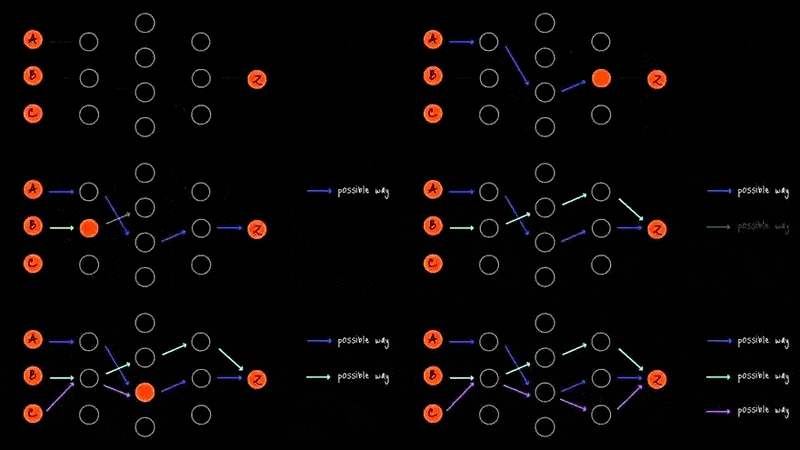
Unlike traditional fiat currencies issued by central banking cartels of our world, XFG is more accurately defined as sound money for its fixed- yet dynamic, money supply of ₲8,000,008. And unlike even most PoW cryptocurrencies today, Fuego was designed to thrive within a disinflationary ecosystem; incentivized by transaction fees and reborn coinbase rewards from burns- ensuring security & block rewards for future generations.
(*) Eldernodes are service nodes which earn a percentage for each txn they relay on Fuego network. For more info and a list of tutorials, see & contribute to our Guides section.
Fuego exists only as a result of open-source contributions and regular people like you & I running free (as in freedom) software on our machines. Whether it be an act of altruism, rebellion, or an act of freedom- our action is what matters. One could even escape the clutches of tyranny (were conditions as such) by simply choosing the routine action of accepting payment(s) in the form decentralized privacy currencies for any peer-based transactions already occurring from normal interactions of everyday, human life. In hoc signo vinces

